Prosper in a dynamic world
Search

Heavy rain and severe thunderstorms set to impact northern Australia this week


The monsoon trough is deepening over northern Australia and is set to bring heavy rainfall and frequent gusty thunderstorms across this week. 

The deepening monsoon trough and associated convective activity have already caused and increase in rain and allowed a couple of low pressure systems to develop. 

One of these low pressure systems developed to the north of the Kimberley late last week. While there were indications that this low could become a tropical cyclone, this now looks unlikely, with the low’s proximity to land restricting its development. This low is expected to weaken on Monday and has a very low chance of developing into a tropical cyclone.  

The satellite image below shows another tropical low to the northwest of the Cocos Islands on Monday morning. This low may briefly move into Australia’s Western Region on Tuesday, before moving west again out of the region. This system will pose no direct threat the mainland of Australia and is also unlikely to develop into a tropical cyclone. 

 MicrosoftTeams-image (197)

Image: The satellite image shows another low to the northwest of the Cocos Islands, the green circle is highlighting its location. 

However, while tropical cyclones look unlikely this week, the lows and monsoonal trough are likely to enhance rainfall and bring severe storms to a broad area of northern Australia extending from the Kimberley, across the northern NT and into eastern tropical QLD. 

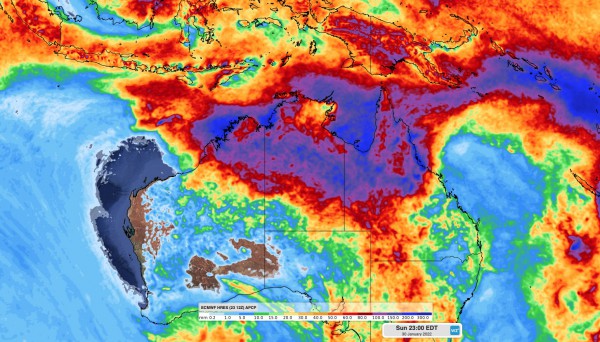
The image below shows this week’s forecast accumulated rainfall, with large rainfall totals expected across northern Australia. With active periods of the monsoon, widespread weekly rainfall totals will likely be more than 100 millimeters, with some places likely to see several hundred millimeters by the end of this week. 

 MicrosoftTeams-image (195)

Image: ECMWF weekly accumulated forecast rainfall to 11pm Sunday, January 30. 

The main threats during this week’s monsoon burst will be heavy rain, flooding, lightning and damaging winds. For more information on Weatherzone’s tropical cyclone, heavy rainfall alerting and thunderstorm forecasting, please contact us at apac.sales@dtn.com.

Latest news

Satisfy your weather obsession with these news headlines from around the nation, and the world.

DTN Dangerous Thunderstorm Alerts in action with severe thunderstorms disrupting Perth industries

Severe thunderstorms impacted southwest WA and the Perth region on Sunday, December 14, 2025, triggering Dangerous Thunderstorm Alerts (DTA) by DTN for industries and businesses in the region. DTN operates Dangerous Thunderstorm Alerts (DTA) which alert businesses and industries to thunderstorms based on intensity and movement. These alerts provide advanced notice of thunderstorms moving into […]

How Australian East Coast port and maritime operations could be disrupted by tropical cyclones over the next two weeks

Port and maritime operations across Australia’s East Coast could be disrupted by increased tropical cyclone activity in the Coral Sea and southwest Pacific Ocean over the next two weeks. Meteorologists reference a large selection of Numerical Weather Prediction (NWP) models to forecast weather. A number of these NWP models are forecasting the development of tropical […]

Extreme fire danger and severe heatwave conditions spreading across SA, Victoria and NSW

Hot, dry and windy weather causing elevated fire danger and severe heatwave conditions are sweeping across southeastern Australia over the next three days, driving high energy demand and disruption to operations. Clear skies associated a large and slow-moving high pressure system have allowed hot air to build up over parts of northern, western and central […]

Heightened bushfire risk during the 2025-26 summer for WA, Victoria and NSW in latest AFAC Outlook

The Australian and New Zealand Council for fire and emergency services (AFAC) identified western and southern WA, Victoria and inland NSW as key regions that are at risk of heightened bushfire risk this summer. Parts of Australia have experienced severe soil moisture and rainfall deficiencies over the past months and years, while high fuel loads […]