Prosper in a dynamic world
Search

Australia on La Nina Alert


The likelihood of La Niña occurring this summer has increased to 70 percent, prompting the Bureau of Meteorology to issue a La Niña Alert on Tuesday.

Over the past few months, sea surface temperatures in the central and eastern equatorial Pacific Ocean have been getting abnormally cool.

This oceanic cooling has also been accompanied by a response in the atmosphere, which has included trade winds strengthening over the central and western Pacific Ocean in the last few weeks.

Both the atmosphere and the ocean are now showing clear signs of being in a La Niña-like pattern and a number of forecast models suggest that this trend will continue in the months ahead.

Back in mid-September, the Bureau of Meteorology issued a La Niña Watch, indicating that there was a 50 percent chance of La Niña forming later this year.

This week, the Bureau has increased this to a La Niña Alert, which means the odds of La Niña have increased to 70 percent.

While it’s still possible that La Niña won’t develop in the coming months, this is now increasingly unlikely.

La Niña typically brings above average rainfall, below average maximum temperatures and above average overnight temperatures across large areas of Australia. It also typically produces more tropical cyclones during Australia’s cyclone season, which runs from November until April.

If we do see a fully-fledged La Niña forming in the next few months, this would be the first back-to-back La Niña event in a decade.

Latest news

Satisfy your weather obsession with these news headlines from around the nation, and the world.

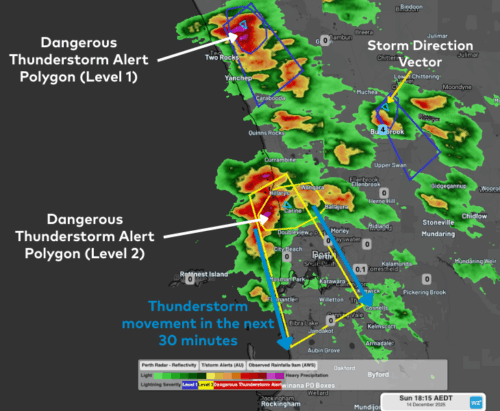
DTN Dangerous Thunderstorm Alerts in action with severe thunderstorms disrupting Perth industries

Severe thunderstorms impacted southwest WA and the Perth region on Sunday, December 14, 2025, triggering Dangerous Thunderstorm Alerts (DTA) by DTN for industries and businesses in the region. DTN operates Dangerous Thunderstorm Alerts (DTA) which alert businesses and industries to thunderstorms based on intensity and movement. These alerts provide advanced notice of thunderstorms moving into […]

How Australian East Coast port and maritime operations could be disrupted by tropical cyclones over the next two weeks

Port and maritime operations across Australia’s East Coast could be disrupted by increased tropical cyclone activity in the Coral Sea and southwest Pacific Ocean over the next two weeks. Meteorologists reference a large selection of Numerical Weather Prediction (NWP) models to forecast weather. A number of these NWP models are forecasting the development of tropical […]

Extreme fire danger and severe heatwave conditions spreading across SA, Victoria and NSW

Hot, dry and windy weather causing elevated fire danger and severe heatwave conditions are sweeping across southeastern Australia over the next three days, driving high energy demand and disruption to operations. Clear skies associated a large and slow-moving high pressure system have allowed hot air to build up over parts of northern, western and central […]

Heightened bushfire risk during the 2025-26 summer for WA, Victoria and NSW in latest AFAC Outlook

The Australian and New Zealand Council for fire and emergency services (AFAC) identified western and southern WA, Victoria and inland NSW as key regions that are at risk of heightened bushfire risk this summer. Parts of Australia have experienced severe soil moisture and rainfall deficiencies over the past months and years, while high fuel loads […]