Prosper in a dynamic world
Search

Can wind be too strong at wind farms?


Australia’s southeastern states have been stuck in a pattern of frequent cold fronts since the end of May, keeping winds strong and wind power output high for most days this past week.  

This spell of windy weather now looks likely to continue for at least another week, with several cold fronts set to sweep across southern Australia during the 2nd week of winter. 

The windiest days across southern Australia are expected on the weekend and possibly into next week across parts of southwestern WA. 

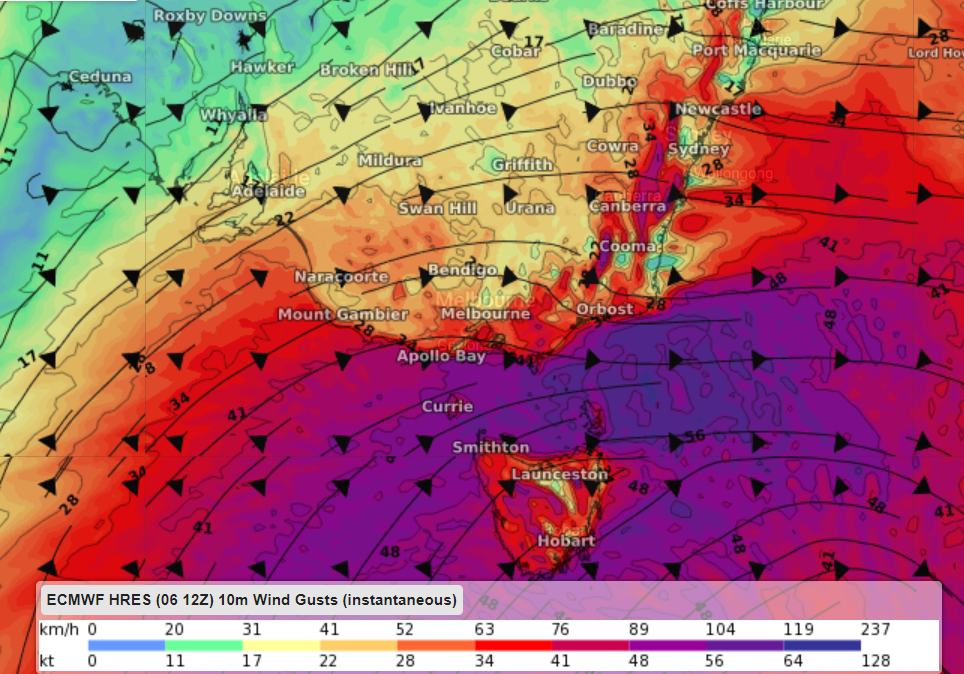
The map below shows the instantaneous wind gust forecast for Saturday evening, with strong winds impacting southeastern Australia. 

 wind gusts

Image: EMWF instantaneous wind gusts at 7pm Saturday, June 12 

While a week of significant wind power is on the cards, the winds are forecast to reach damaging strength across several states and territories at times over the next week. 

Is this wind too strong for wind farms?
 

Strong winds are usually great news for wind farms. However, sometimes the winds are too strong. There is a sweet spot when it comes to wind power.   

Wind gusts above 90km/h (25m/s) can damage the wind turbines and the propellers if they are spinning in these winds. 

Most wind farms turn off the turbines if the wind speed reaches the ‘cut off’ wind speed of 90km/h (25m/s) to prevent damage to the turbines.  

Unfortunately, if the propellers are turned off on the turbines due to high winds, wind power is not being harnessed. During these periods of intense winds, wind power capacities will be reduced as long as the turbines remain turned off.  

During the next 48 hours or so, wind speeds should be strong but not strong enough for cut offs. However, from Thursday gusts could exceed the criteria forcing some wind farms to turn the propellers off and reducing the capacity.  

DTN APAC, a DTN company, offers wind and power generation forecasting to assist in determining your wind farm’s output, reducing costly error. For more information, please contact us a at apac.sales@dtn.com.  
Latest news

Satisfy your weather obsession with these news headlines from around the nation, and the world.

DTN Dangerous Thunderstorm Alerts in action with severe thunderstorms disrupting Perth industries

Severe thunderstorms impacted southwest WA and the Perth region on Sunday, December 14, 2025, triggering Dangerous Thunderstorm Alerts (DTA) by DTN for industries and businesses in the region. DTN operates Dangerous Thunderstorm Alerts (DTA) which alert businesses and industries to thunderstorms based on intensity and movement. These alerts provide advanced notice of thunderstorms moving into […]

How Australian East Coast port and maritime operations could be disrupted by tropical cyclones over the next two weeks

Port and maritime operations across Australia’s East Coast could be disrupted by increased tropical cyclone activity in the Coral Sea and southwest Pacific Ocean over the next two weeks. Meteorologists reference a large selection of Numerical Weather Prediction (NWP) models to forecast weather. A number of these NWP models are forecasting the development of tropical […]

Extreme fire danger and severe heatwave conditions spreading across SA, Victoria and NSW

Hot, dry and windy weather causing elevated fire danger and severe heatwave conditions are sweeping across southeastern Australia over the next three days, driving high energy demand and disruption to operations. Clear skies associated a large and slow-moving high pressure system have allowed hot air to build up over parts of northern, western and central […]

Heightened bushfire risk during the 2025-26 summer for WA, Victoria and NSW in latest AFAC Outlook

The Australian and New Zealand Council for fire and emergency services (AFAC) identified western and southern WA, Victoria and inland NSW as key regions that are at risk of heightened bushfire risk this summer. Parts of Australia have experienced severe soil moisture and rainfall deficiencies over the past months and years, while high fuel loads […]