Prosper in a dynamic world
Search

Albury’s heaviest rain in 160 years


Relentless rain has fallen along parts of the NSW-Vic border during the past 24 hours, with Albury registering its wettest day since 1863.

A near-stationary band of heavy rainfall developed along a convergence line in the Albury-Wodonga region of southern NSW and northeast Vic on Sunday night.

This deluge, which was being fuelled by a mass of unusually humid air, produced an entire summer’s worth of rain in just 24 hours at some locations.

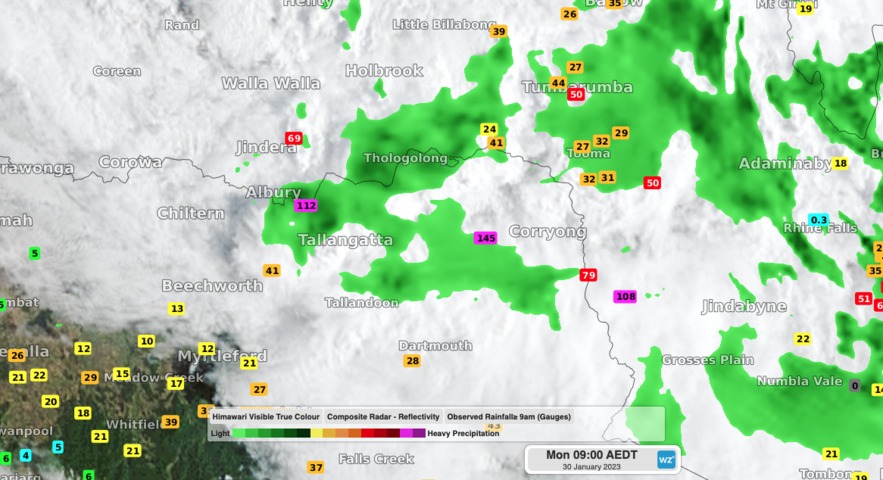
Video: Composite radar, satellite and rainfall observations during the 24 hours ending at 9am on Monday, January 30, 2023.

Albury Airport collected 132 mm during the 24 hours ending at 9am on Monday. This is Albury’s wettest day since 1863 and roughly equal to its long-term seasonal summer average of 135 mm. Some of the most intense rain fell overnight, with 65mm hitting the gauge during the 6 hours ending at 2am on Monday.

Albury has one of Australia’s longest available periods of records for rainfall, with data stretching back to 1858. This past 24 hour’s rain was the 2nd highest daily total in this lengthy period, beaten only by 167.6 mm from April 1 in 1863.

Nearby, the 134 mm of rain that fell at Hume Dam during the 24 hours to 9am on Monday, which was its highest daily total in records dating back to 1922.

Across the border in northeast Vic, Hunters Hill picked up 149.6 mm in the same period, including 48.4 mm in just three hours.

Showers will ease over southern NSW and northern Vic as a low pressure trough moves further north, away from the region.

Latest news

Satisfy your weather obsession with these news headlines from around the nation, and the world.

A warm, light wind spring ahead for the NEM

A strong El Niño and an unusually stable Antarctic polar vortex are setting up a spring signal of light winds, elevated solar output, and a real risk of high-intensity heatwaves for the NEM.   This forecast could be a major flip to what the National Electricity Market (NEM) has experienced so far during Winter 2026. On 1 July 2026, the NEM […]

Habagat and successive typhoons trigger widespread flooding in the Philippines

Three consecutive weeks of enhanced southwest monsoon (Habagat) and back-to-back typhoons have flooded Luzon and the Visayas, grounding flights, triggering distribution power outages, cutting off transport corridors, and raising landslide risk across mining-dense provinces like Benguet and the Cordillera. The disruption is far from over with PAGASA expecting the monsoon to remain in place until […]

Australia’s Spring 2026 Bushfire Outlook: Increased Risk Across Seven States and Territories

Fire agencies, land managers and businesses are being urged to prepare as the AFAC spring seasonal bushfire outlook, released on August 19, 2026, warns of elevated bushfire risk across Australia this season. The outlook identifies above-average fire danger across seven states and territories, with conditions driven by a combination of elevated fuel loads, an El Niño […]

Businesses under pressure: how this powerful high will affect Australian industries

A very strong high pressure system centred over Tasmania will impact southern and eastern Australia’s weather over the coming days. How strong is this high pressure system? Mean Sea Level Pressure (MSLP) has already reached 1039.3 hPa at Ouse, Tasmania on Sunday morning, and is forecast to peak at 1041 or 1042 hPa on Monday […]