Prosper in a dynamic world
Search

Coldest day in years, frost on the way in WA


Parts of southwestern Australia just shivered through their coldest day in more than a decade as a polar air mass hit WA.

The sequence of satellite images below shows a cold front and trailing polar air mass passing over the southwest of WA during the last two days.

Video: Composite infrared/visible satellite images over the past 48 hours, showing cold air spreading over southwestern Australia on Monday and Tuesday.

On Tuesday, Perth only reached a maximum temperature of 12.4ºC, which is about 7ºC below average for this time of year. This made Tuesday the city’s coldest day in two years and its fourth coldest day this century.

Nearby, Bickley’s top temperature of 9.4ºC on Tuesday was its coldest day since 2005 and its coldest August day in records dating back to 1994.

These abnormally low temperatures were made possible by a cold air mass combined with frequent rain and cloud cover, with Perth collecting close to 40mm of rain during the 48 hours to 9am on Wednesday. In the far south of WA, some of Tuesday’s precipitation even fell as snow on the Stirling Range.

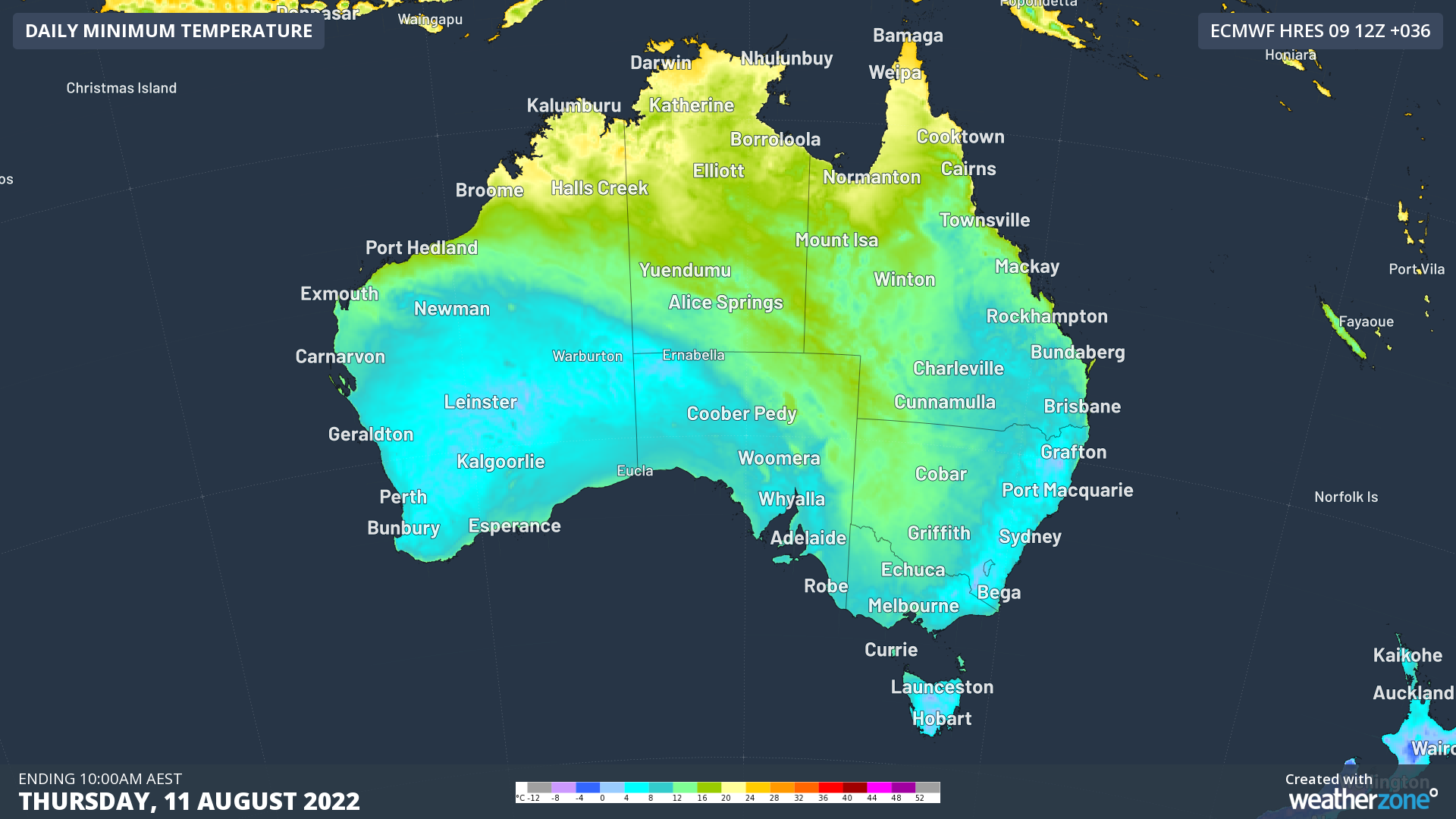
Daytime temperatures will gradually warm up over the next few days, with Perth forecast to reach about 17ºC on Wednesday and up to 21ºC by Friday. However, clear skies and lighter winds will cause very cold overnight temperatures across southern WA over the next few nights, with frost likely over the state’s southern inland.
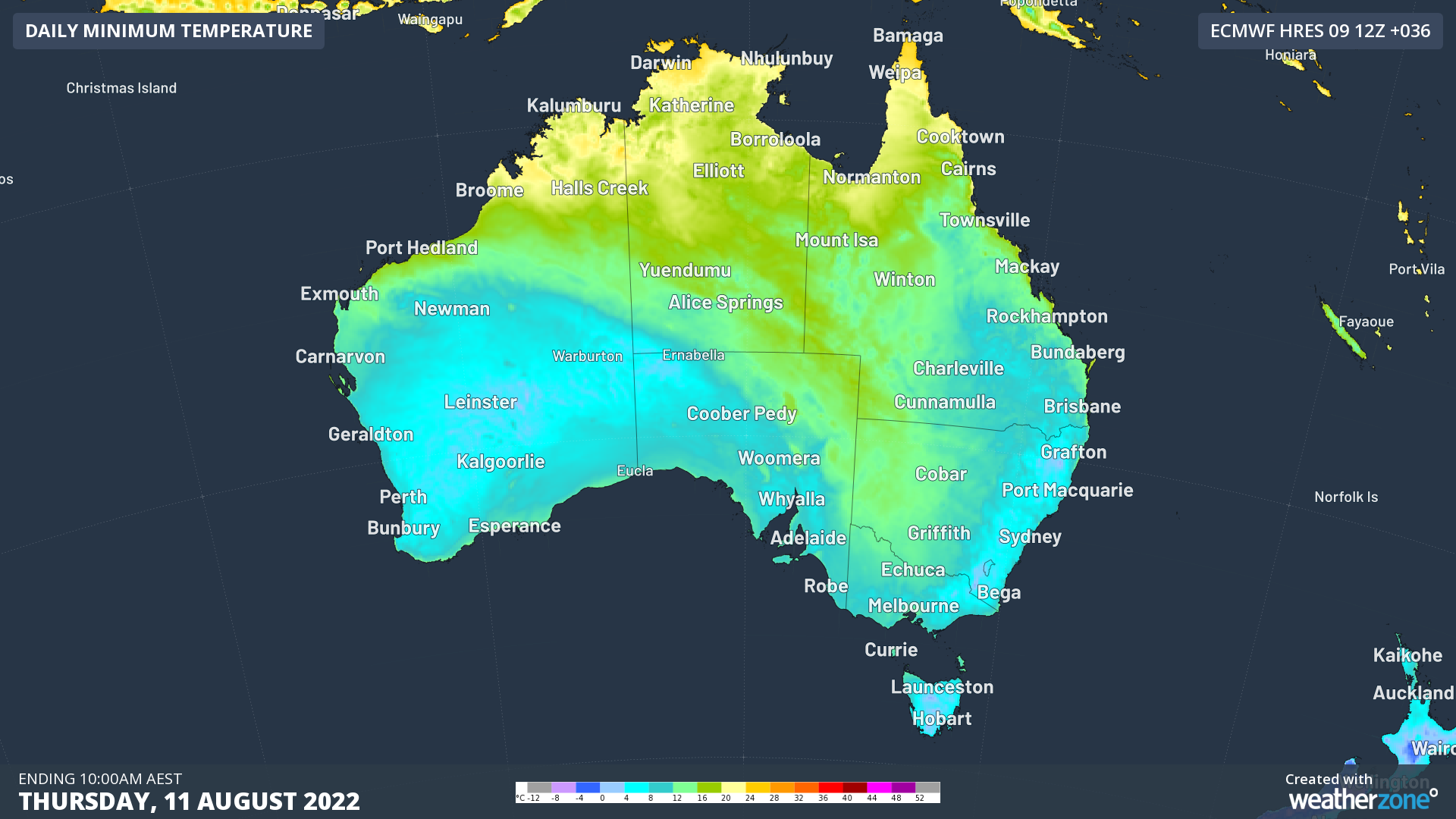
Image: Forecast minimum temperatures on Thursday morning according to the ECMWF-HRES model.

For more information on our energy forecasts, please contact us at bsuiness@weatherzone.com.au.
Latest news

Satisfy your weather obsession with these news headlines from around the nation, and the world.

A warm, light wind spring ahead for the NEM

A strong El Niño and an unusually stable Antarctic polar vortex are setting up a spring signal of light winds, elevated solar output, and a real risk of high-intensity heatwaves for the NEM.   This forecast could be a major flip to what the National Electricity Market (NEM) has experienced so far during Winter 2026. On 1 July 2026, the NEM […]

Habagat and successive typhoons trigger widespread flooding in the Philippines

Three consecutive weeks of enhanced southwest monsoon (Habagat) and back-to-back typhoons have flooded Luzon and the Visayas, grounding flights, triggering distribution power outages, cutting off transport corridors, and raising landslide risk across mining-dense provinces like Benguet and the Cordillera. The disruption is far from over with PAGASA expecting the monsoon to remain in place until […]

Australia’s Spring 2026 Bushfire Outlook: Increased Risk Across Seven States and Territories

Fire agencies, land managers and businesses are being urged to prepare as the AFAC spring seasonal bushfire outlook, released on August 19, 2026, warns of elevated bushfire risk across Australia this season. The outlook identifies above-average fire danger across seven states and territories, with conditions driven by a combination of elevated fuel loads, an El Niño […]

Businesses under pressure: how this powerful high will affect Australian industries

A very strong high pressure system centred over Tasmania will impact southern and eastern Australia’s weather over the coming days. How strong is this high pressure system? Mean Sea Level Pressure (MSLP) has already reached 1039.3 hPa at Ouse, Tasmania on Sunday morning, and is forecast to peak at 1041 or 1042 hPa on Monday […]