Prosper in a dynamic world
Search

Oracle captures the Papua New Guinea storm this week


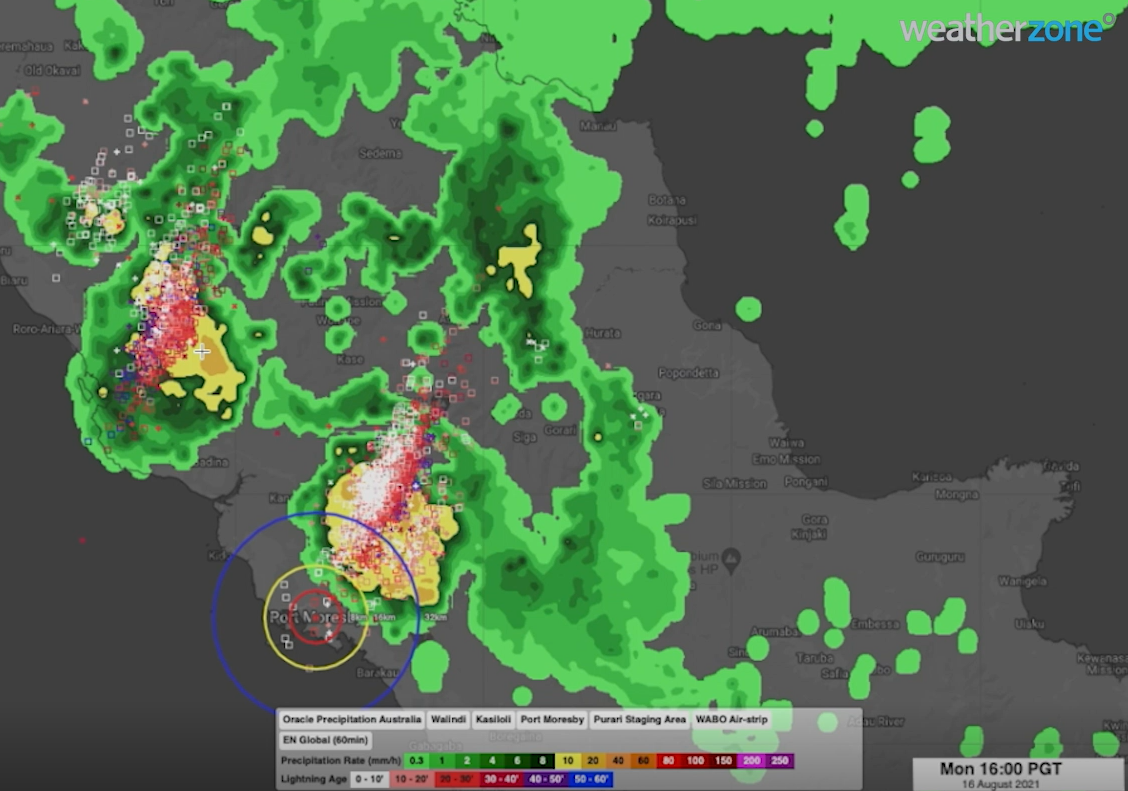
A thunderstorm rolled into Port Moresby, Papua New Guinea from the west on Monday, August 16, with little warning to locals about the Papua New Guinea storm due to sparse radar coverage (figure 1).

Oracle our new ‘radar’ system captured the storm, lightning, and heavy rainfall perfectly, well in advance and before the storm made its way through Port Moresby. 

Our clients in Port Moresby, with Oracle, were warned well in advance of the storm and rainfall, with the ability to track the storm. This enabled our clients to plan and prepare for the storm ahead of time, which is key for safety and productivity.  

Figure 1: Oracle radar capturing lightning and heavy rainfall between 1-4pm PGT on Monday, August 16, 2021.  

The Papua New Guinea storm (figure 1) illustrated the power of the Oracle system; however, it is worth noting this can be deployed anywhere in the world. 

 This storm clearly demonstrated the power of the Oracle system near Port Moresby. However, it is worth noting that Oracle can be deployed anywhere in the world, enabling users to see rain as it is happening wherever they are.  

In addition to tracking current rain, Oracle also provides live forecasts of rainfall rates, lightning, and cloud for up to three hours in advance, for anywhere in the world. 

It does this by feeding live satellite imagery, lightning data and nearby radar imagery into the forecast system. This innovative technology was built in collaboration with Solcast.  

Oracle is a more than adequate replacement for radar, but the genius of it is that it’s also a one-of-a-kind forecast system, delivering accurate forecasts out to four hours.  

Stay tuned for additional updates on Oracle’s new forecasting capabilities. For more information, please contact us at apac.sales@dtn.com.  
Latest news

Satisfy your weather obsession with these news headlines from around the nation, and the world.

Australia’s 2026-27 Tropical Cyclone Season: Late Start, Real Risk

Australia’s tropical cyclone season is officially underway, but we may not see much activity for few months yet.  The season runs from November to April, and for mining operators and businesses across northern Australia, 2026-27 is shaping up to be a season where the headline numbers and the real risk may not line up.  On […]

Positive IOD declared: Not a typical dry signal for Australia

A positive Indian Ocean Dipole is underway, but this one is unlikely to deliver the textbook dry spring and summer that businesses have come to expect from the pattern.  The Bureau of Meteorology officially declared a positive IOD on Tuesday, October 27, which typically like El Niño can cause drier and warmer conditions over parts of […]

Signs of a positive Indian Ocean Dipole, but it may not follow the textbook

Waters off Indonesia have cooled in recent weeks, an indication that a positive Indian Ocean Dipole (IOD) event could be developing. It’s an important climate driver for Australia, and it could shape rainfall and temperatures heading into summer, with flow-on effects for farmers, energy and other industries.  What is the Indian Ocean Dipole?  The IOD […]

1.3 million lightning strikes and a record September downpour: the storms testing WA’s Goldfields

Leonora, WA, had its wettest September day on record earlier this month. Three weeks later, more than 1.3 million lightning pulses were detected within 800 km of the town in 48 hours. Why is a stalled trough delivering storms to mining country, and what it could mean for operations?  The DTN Total Lightning Network detected […]