Prosper in a dynamic world
Search

Another 40ºC day in Perth, afternoon storms possible

Temperatures are going to soar in Perth and other areas of southwestern Australia today, with thunderstorms also on the cards from this afternoon.

A low pressure trough will draw a very hot air mass towards Australia’s west coast on Tuesday. The presence of this west coast trough will help delay the sea breeze in Perth, which should allow the mercury to climb to around 41ºC in the city and possibly a couple of degrees higher at the airport.

This will be Perth’s second day above 40ºC so far this month after the city hit 40.7ºC last Saturday, well above its January average maximum temperature of 31ºC.
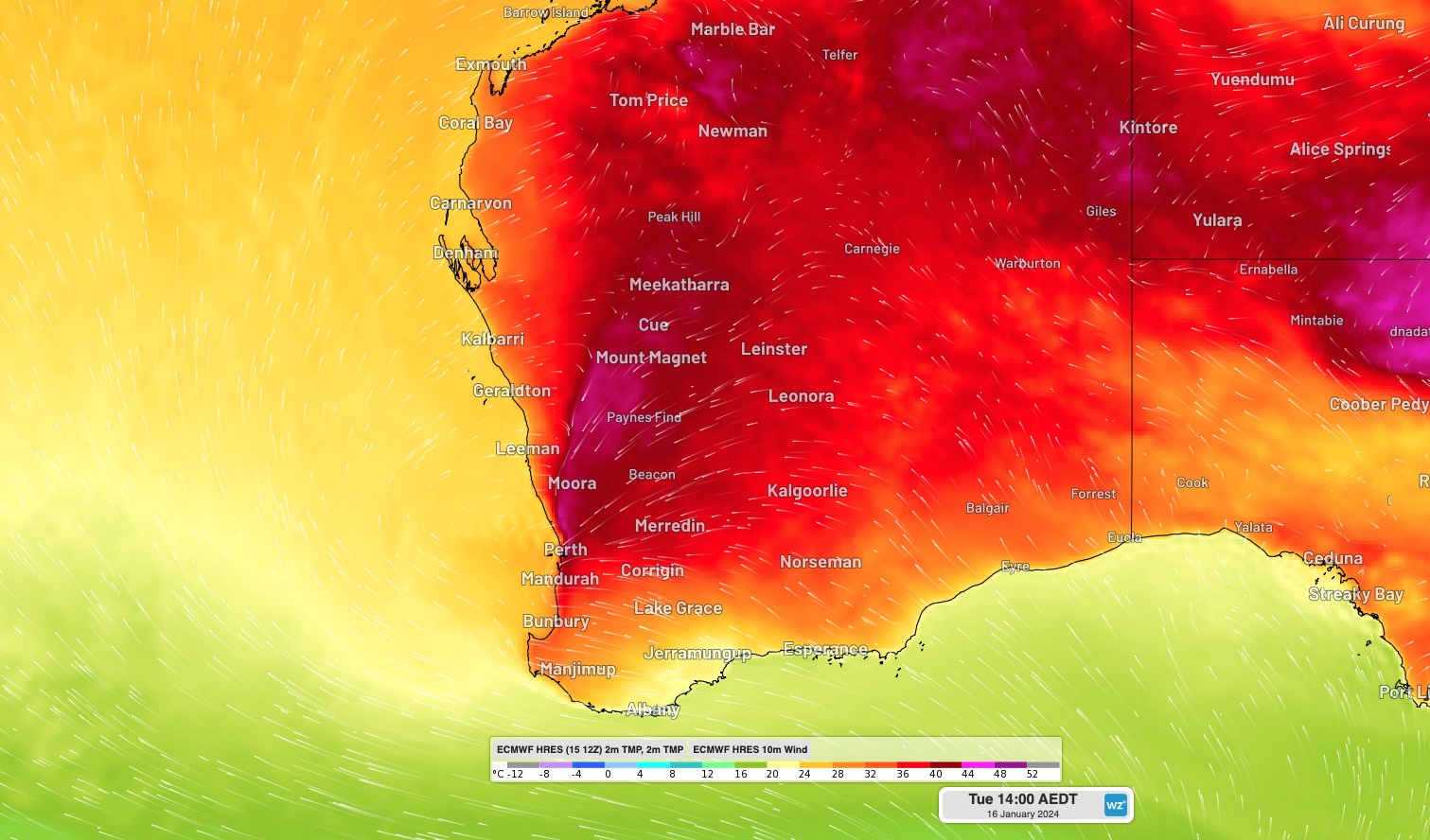
Image: Forecast air temperature and wind at 11am AWST on Tuesday, January 16, according to the ECMWF-HRES model.

Tuesday’s hot weather will help cause high fire danger across most of southwestern Australia, while extreme fire danger is forecast in the Burrup District in the state’s far southwest, which contains Busselton, Margaret River and Augusta.

The intense surface heating on Tuesday could also help give rise to thunderstorms across the southwest inland of WA from the afternoon.

The convective shower activity that could mature into thunderstorms will most likely occur to the east of Perth, from the Darling Scarp across the wheatbelt and possibly into parts of the Gascoyne and Goldfields districts. However, storms are possible in the city, most likely in the eastern suburbs.

Some of the storms that develop in the southwest of WA on Tuesday could become severe, so be sure to check the latest storm warnings throughout the afternoon and evening. Also monitor the Emergency WA website for the most up-to-date information on bushfires across the state.

DTN APAC has all of your mining and energy forecasting and weather safety needs covered. To find out more please email us at apac.sales@dtn.com.
Latest news

Satisfy your weather obsession with these news headlines from around the nation, and the world.

Signs of a positive Indian Ocean Dipole, but it may not follow the textbook

Waters off Indonesia have cooled in recent weeks, an indication that a positive Indian Ocean Dipole (IOD) event could be developing. It’s an important climate driver for Australia, and it could shape rainfall and temperatures heading into summer, with flow-on effects for farmers, energy and other industries.  What is the Indian Ocean Dipole?  The IOD […]

1.3 million lightning strikes and a record September downpour: the storms testing WA’s Goldfields

Leonora, WA, had its wettest September day on record earlier this month. Three weeks later, more than 1.3 million lightning pulses were detected within 800 km of the town in 48 hours. Why is a stalled trough delivering storms to mining country, and what it could mean for operations?  The DTN Total Lightning Network detected […]

A very low wind power week, likely to continue

A stubborn blocking high over southern Australia will make for a very quiet week for wind generation and the pattern behind it isn’t a one-off.   It’s the seasonal signature of a super (very strong) El Niño combined with a positive Southern Annular Mode (SAM), and both the historical record and the current seasonal forecast suggest it’s likely to keep recurring through spring before a potential switch from November.  The setup right […]

Fastest strengthening El Niño on record: Impacts on Australian monsoon timing and wet season planning

Australia’s Mining and Resources sectors are bracing for a wet season shaped by one of the most rapidly developing El Niño events on record.    Looking back at how the strongest El Niño events in Australian history have played out, it becomes apparent that mining operations in Australia should be planning for a later monsoon […]