
Prosper in a dynamic world
Search

Active storm week to be captured by Total Lightning Network


Australia set to see active thunderstorm week

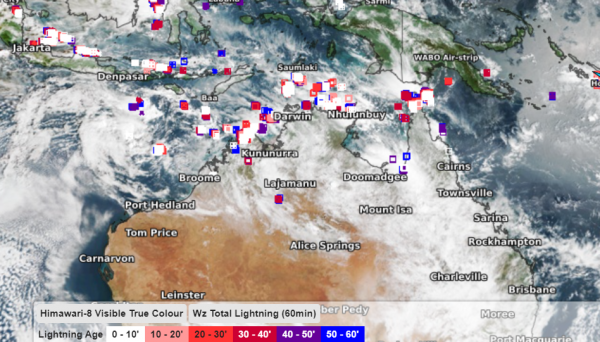
Australia is set to see a very active thunderstorm week as the monsoon trough deepens over northern QLD. 

During this week’s monsoon, severe thunderstorms are likely to impact parts of NT, northern WA and QLD. These storms have the potential to produce heavy rain, flooding, lightning and damaging wind in these regions.  

Visible satellite images and Weatherzone’s total lightning network captured lightning strikes at 11:10am Tuesday, January 25

Meanwhile the southern states are enduring hot and sticky weather which will trigger thunderstorms for several days this week. Severe thunderstorms are also likely across southern Australia, with more heavy rainfall on the cards for SA, VIC and NSW. 

Weatherzone’s total lightning Network is driven by Earth Networks Total Lightning Network®. This network delivers the most reliable and precise lightning detection in the world, so you can make better decisions, protect property, minimize downtime, and safeguard lives when and where it matters most.  

Our expansive network provides the most reliable, high-quality data in real time to help you quickly evaluate risk and act when dangerous weather threatens. 

We are excited to announce an upgrade to our customers’ lighting detection service has been deployed recently. 

We have been working closely with our lightning detection partner, Earth Networks for some time who have made significant improvements to their detection algorithms.  

Key Improvements  

  1. Improved location accuracy. By prioritising higher performing sensors and improving distance calculation the location accuracy has been significantly improved. 
  2. Increased detection. We have seen increased detection of 20% – 25%. You will notice a greater volume of data coming through.
  3. Improved classification. Better classification of Cloud to Cloud and Cloud to Ground strikes.

Both WZTLN (Australia) and ENGLN (Global) feeds will greatly benefit from these upgrades. 

This upgrade has been deployed today, for more information, please contact us at business@weatherone.com.au.  

Latest news

Satisfy your weather obsession with these news headlines from around the nation, and the world.

From Kimberley to northern NSW: Bushfire outlook flags risk for resources sector this winter

Bushfire risk doesn’t usually make headlines in June, but AFAC’s winter seasonal outlook is putting mining and resources operators on alert from the Kimberley to the NSW.  Australia’s official seasonal bushfire outlook for winter 2026 was released by AFAC on Thursday, May 28. The outlook predicts increased fire risk across the northern parts of the Great Sandy Desert and surrounds […]

The signal was there weeks earlier: forecasting one of the year’s biggest wind events

In mid-May 2026, DTN APAC meteorologists flagged a strengthening Southern Ocean pattern in model guidance, signalling an extended run of record-challenging wind conditions across the NEM.  Nearly three weeks later, NEM wind generation climbed from around 1.5GW to more than 9GW, supplying roughly one-third of the grid and coming within 1GW of the all-time generation record.  The event highlighted […]

The 2026 Indian Southwest Monsoon onset is expected in the next two weeks

The Indian Southwest Monsoon will reach India in the next two weeks, but a developing El Niño could signal a drier than normal monsoon for businesses and major industries across the country. Southwest monsoon onset over southern India in the next two weeks The Indian Meteorological Department (IMD) is responsible for tracking the advance and […]

Rapid El Niño signal accelerating risk for Australian businesses

El Niño–favourable conditions are gathering pace across the tropical Pacific, with key ocean indicators approaching threshold levels and early atmospheric responses emerging.  While uncertainty remains around final El Niño strength, historical analogues show that even weak events can generate widespread impacts, including reduced rainfall, warmer daytime temperatures, increased frost risk, elevated fire danger, reduced tropical cyclone activity, and more. Industries including […]


