
A series of very long period swells will bring deceptively powerful waves to NSW ports.
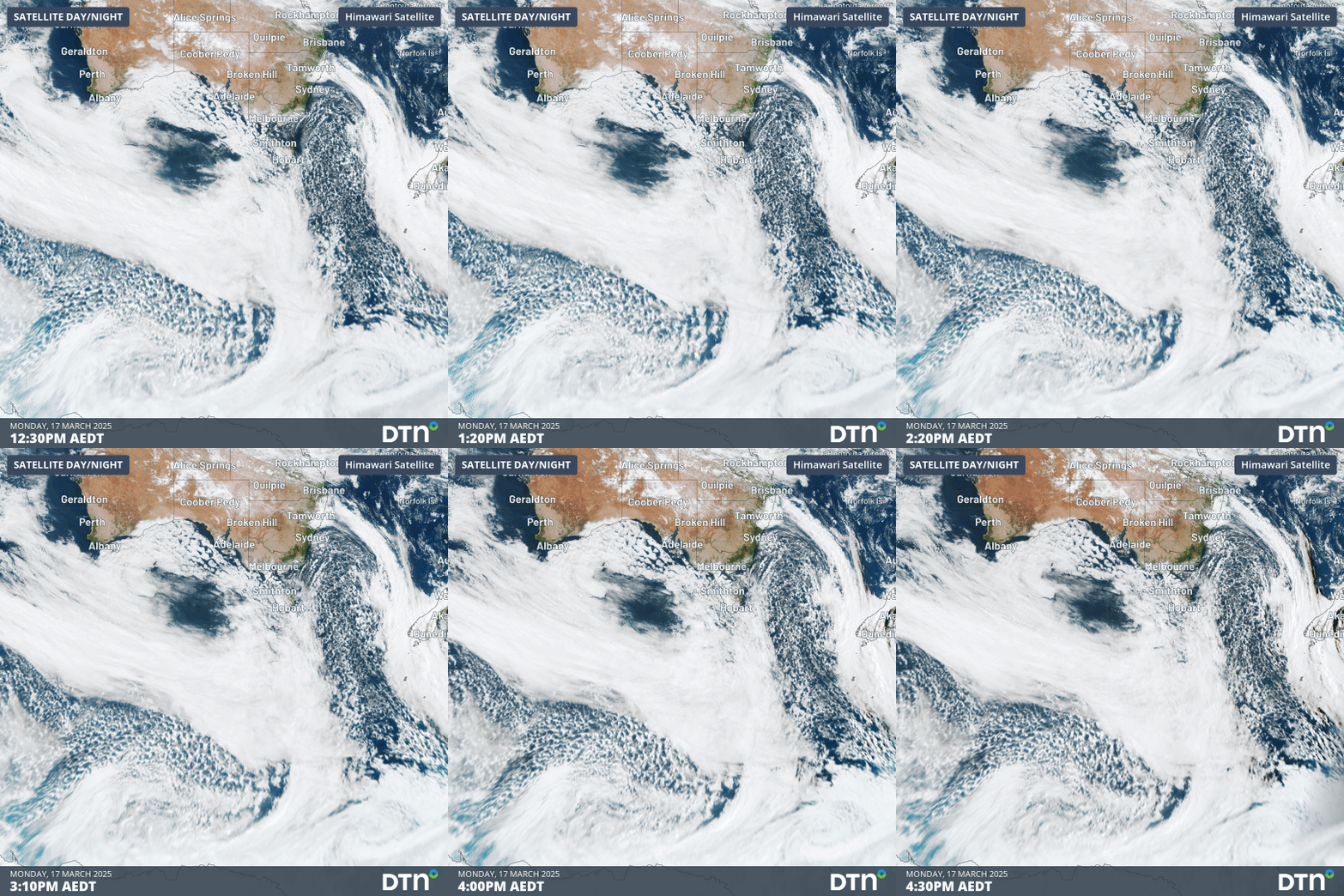
Image: Satellite loop of powerful lows well to the south of Australia on Monday, March 17.
A very active period with powerful low pressure systems crossing well to the south of Australia over the past weekend and early week have generated very large waves thousands of kilometres south of the continent.
As seen in the figures below, significant wave heights exceeding 10 metres were generated on Monday, March 17, over 3000 kilometres away from NSW. The US’s National Oceanic and Atmospheric Administration (NOAA) satellite altimeters verified this data with wave heights of 11 metres recorded in the region.

Image: DTN’s OneFX Significant Wave Height forecast on Monday, March 17, afternoon.
Most of this energy will be sent due east, towards New Zealand’s South Island and into the South Pacific. However, some of the energy will radiate north, lapping into parts of the Australian coastline. In the 3000 kilometres journey to NSW, the swell height will dramatically flatten, but the swell period will lengthen significantly.
The first of these long period swells filtered into NSW and the Sydney region this morning, on Wednesday, March 19. The plot below shows a number of different swells in the water, with a peak period of 14-15 seconds.
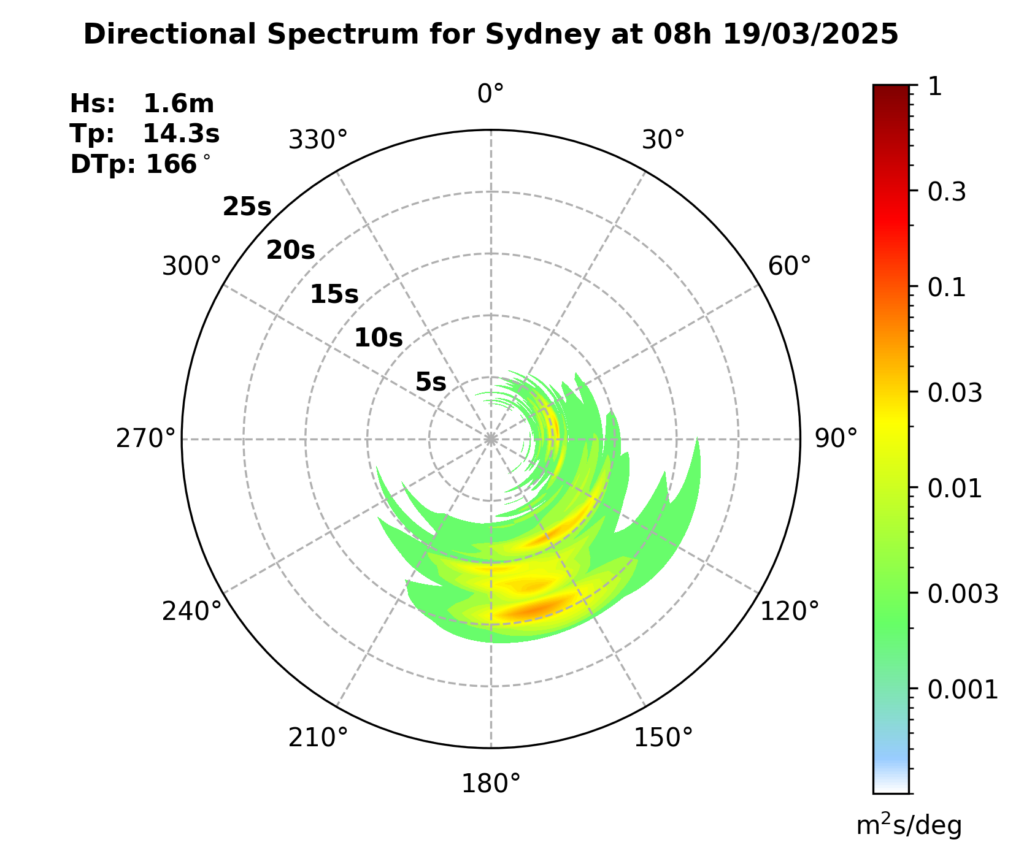
Image: Directional Spectrum swell analysis for Sydney on the morning of Wednesday, March 19, with a dominant swell from the south with a peak period of 14 seconds. Source: Manly Hydraulics Laboratory
This initial groundswell will ease in period to about 12-13 seconds on Thursday. A reinforcing groundswell should filter into the region on Thursday morning with a period of 17-19 seconds.
Why period matters?
While each swell train should only have average heights of about 0.5 metres, the wave power of an 18 second period wave is double that of a wave with a period of 9 seconds. Along with that, the longer period swell ‘feels’ the ocean bottom four times deeper than the 9 second swell. This allows the waves to turn into the coast at a much deeper depth through the process of refraction, impacting the coast more head on, as seen in the figure below.
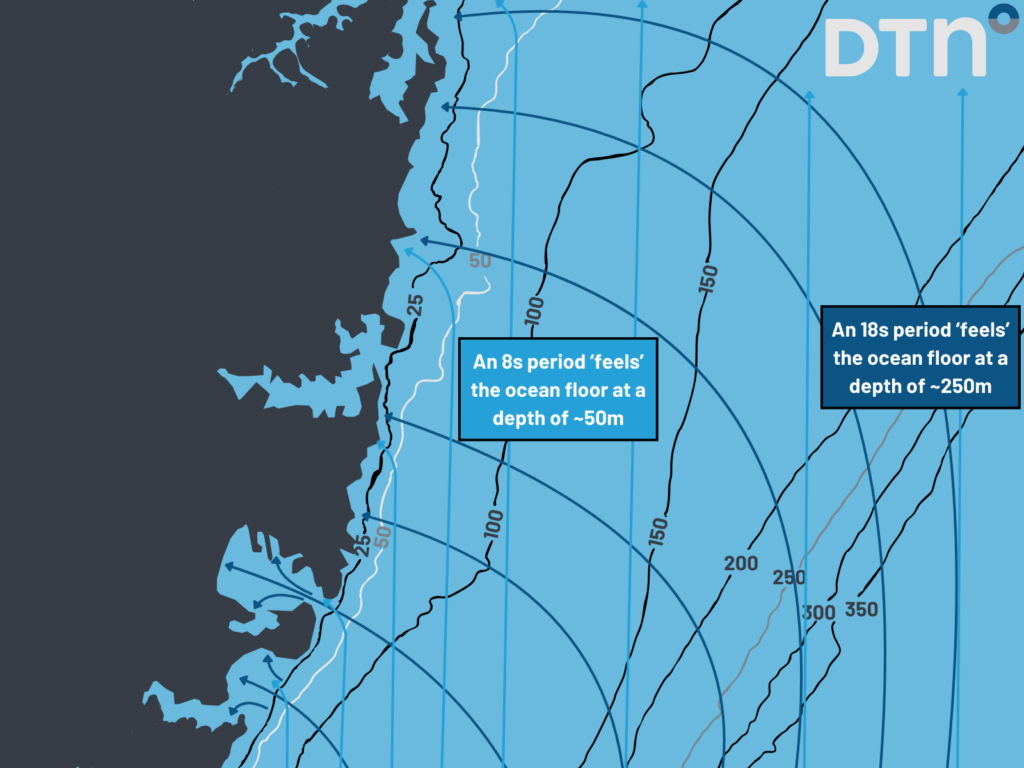
Image: graphic showing how various swell periods interact with the ocean floor at different depths.
In the harbours, the distant nature of these swells will lead to big lulls with generally calm ocean conditions. Every 10-15 minutes, surges of wave energy will pulse into harbours and anchorages as wave sets move into the coast. The size of these pulses will not be huge, but the ebb and flow could cause boats to drag on their moorings and anchors.
How DTN APAC can help
DTN APAC offers a comprehensive suite of services, refined through years of collaboration with the marine, ports and offshore industries, to optimise the safety and efficiency of your operations.
We work with you to understand your intrinsic operational challenges and customise high-precision forecasting, metocean and aviation services to your exact location and operational scope.
When working offshore, our solutions can underpin planning and safe execution for offshore oil and gas enterprises and wind farms. Our data can support your exploration, development, rig moving, shuttle tanker operations, and production and decommissioning phases. Whether your crews are on-site, being transported to shore, or diving to perform maintenance, we deliver tailored weather risk briefings to ensure you choose the optimal time to proceed.
DTN APAC’s trusted nowcasting and forecasting system, OpticastTM, allows you to rapidly respond to changing conditions offshore, en route and in port. We take your port topography and berth orientation into account, ensuring site-specific forecasts. For offshore oil & gas, wind farms, ports and logistics, we have your weather situational awareness covered, no matter where you are. We deliver real-time severe weather and lightning alerts to your team via your integrated dashboard: Portzone, and our Weatherguard app.
DTN APAC’s Total Lightning Network (TLN) ensures you avoid hours of unnecessary downtime by providing the most accurate technology in lightning detection and alerting. Safeguard your teams and assets with lighting and Dangerous Thunderstorm Alerts (DTAs), customised to your existing parameters and delivered in real-time across all devices in your network. You gain full spatial awareness of developing severe weather systems, allowing you to plan ahead and, where needed, execute your shutdown and evacuation procedures.
With extreme conditions slowing production and affecting infrastructure, safety and transport, trust us to deliver Australia’s most precise weather data and tailored insights, giving you decisive confidence when it’s most needed.
To find out more about large range of products and services contact us at sales.apac@dtn.com




