Prosper in a dynamic world
Search

Is the volcanic ash passing over QLD impacting aviation?


A cloud of volcanic ash and gas can be seen passing over QLD today, turning the sky red and disrupting flights in the region. 

A large plume of ash and gas was ejected into the atmosphere on Saturday when the Hunga Tonga Hunga Ha’apai erupted near Tonga. 

Since then, the volcanic cloud has been travelling through the stratosphere towards Australia. 

The satellite images below show the cloud of ash/gas passing over QLD on Monday. 

Video: Visible satellite imagery showing the ash cloud move from east to west over QLD on Monday. 

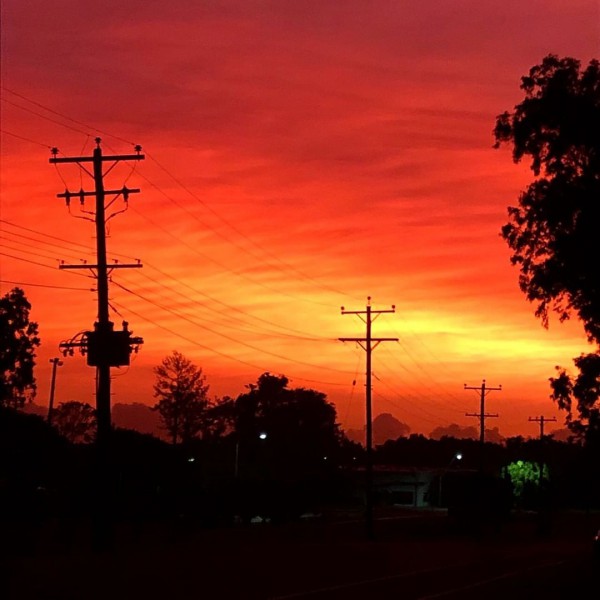
The ash cloud is travelling more than 40,000 feet (around 12km) above sea level, which means it’s too high up in the atmosphere to directly impact Queensland. The ash cloud is however causing flight disruptions in Australia and brought an eerily beautiful sunrise across Queensland on Monday morning.  

MicrosoftTeams-image (190)

MicrosoftTeams-image (187)


MicrosoftTeams-image (186)

Images: Volcanic sunrise in Cairns on Monday morning, as light from the rising sun illuminated the underside of a volcanic ash cloud passing over QLD. Source: Russ Reynolds (top), @gumguy_cns/Instagram (middle) and @globalgourmetqldcairns/Instagram 

How does volcanic ash disrupt aviation?  

Volcanic ash is composed of fine rock, minerals, glass and gas which can cause a loss of thrust and/or engine failure in aircraft. For this reason, volcanic ash can be life-threatening to aircraft passengers and pilots. 

Volcanic ash warnings are issued so aircraft can avoid this deadly cloud. When the ash cloud is thick and unavoidable, aircraft can be grounded for days, causing passengers and cargo to remain stuck at their location. 

Fortunately, aircraft flying across Queensland on Monday will be able to avoid the ash cloud by flying below it. Typically, domestic aircraft fly between 30,000 and 40,000 feet and the ash cloud is located between about 42,000 and 63,000 feet. 

However, there may be some minor disruptions to flight schedules as restrictions are applied to certain flight levels over QLD. For more information on Weatherzone’s aviation services, please contact us at apac.sales@dtn.com.
Latest news

Satisfy your weather obsession with these news headlines from around the nation, and the world.

Signs of a positive Indian Ocean Dipole, but it may not follow the textbook

Waters off Indonesia have cooled in recent weeks, an indication that a positive Indian Ocean Dipole (IOD) event could be developing. It’s an important climate driver for Australia, and it could shape rainfall and temperatures heading into summer, with flow-on effects for farmers, energy and other industries.  What is the Indian Ocean Dipole?  The IOD […]

1.3 million lightning strikes and a record September downpour: the storms testing WA’s Goldfields

Leonora, WA, had its wettest September day on record earlier this month. Three weeks later, more than 1.3 million lightning pulses were detected within 800 km of the town in 48 hours. Why is a stalled trough delivering storms to mining country, and what it could mean for operations?  The DTN Total Lightning Network detected […]

A very low wind power week, likely to continue

A stubborn blocking high over southern Australia will make for a very quiet week for wind generation and the pattern behind it isn’t a one-off.   It’s the seasonal signature of a super (very strong) El Niño combined with a positive Southern Annular Mode (SAM), and both the historical record and the current seasonal forecast suggest it’s likely to keep recurring through spring before a potential switch from November.  The setup right […]

Fastest strengthening El Niño on record: Impacts on Australian monsoon timing and wet season planning

Australia’s Mining and Resources sectors are bracing for a wet season shaped by one of the most rapidly developing El Niño events on record.    Looking back at how the strongest El Niño events in Australian history have played out, it becomes apparent that mining operations in Australia should be planning for a later monsoon […]