
Prosper in a dynamic world
Search

A very wet weekend ahead for NSW

Rainfall is set to intensify over the weekend and early next week, with hundreds of millimetres in just three days possible across parts of the central NSW coastline. 

The heavy rainfall forecast at the end of this week will follow a prolonged period of rainfall which began on Tuesday, generated by a coastal trough lingering off the NSW coast for days. 

Nord’s Wharf Oval in the Hunter Valley recorded 93mm in the 24 hours leading up to 9am Wednesday, May 5. To the west of that station Cooranbong recorded its wettest day in 13 years with 52.4mm falling during the same period.  

The satellite image below shows a mass of cloud and rainfall around the central NSW coastline on Wednesday afternoon.  
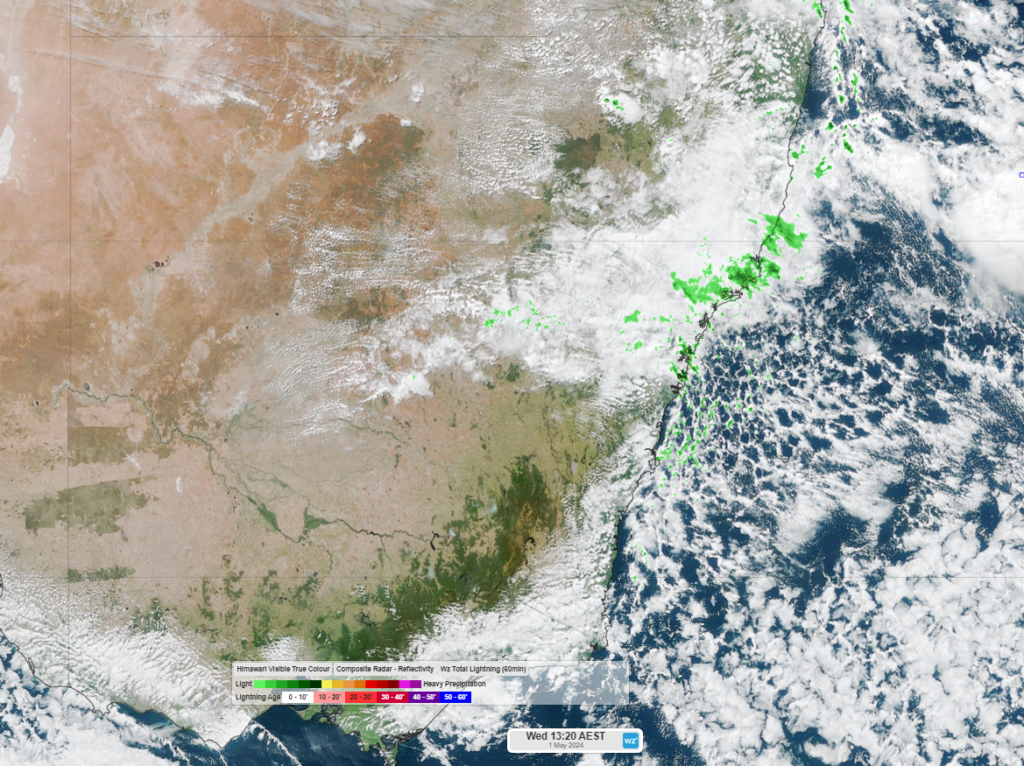
Image: Himawari-9 satellite image at 1:20pm AEST on Wednesday, May 1 

While rainfall is expected to fall each day from now until the weekend, the heaviest falls are expected between Saturday and Tuesday as an upper-level low approaches NSW. During this period the central and northern NSW coasts, including Sydney, are forecast to see widespread falls of 60-120mm with isolated falls exceeding 200mm in some areas. 

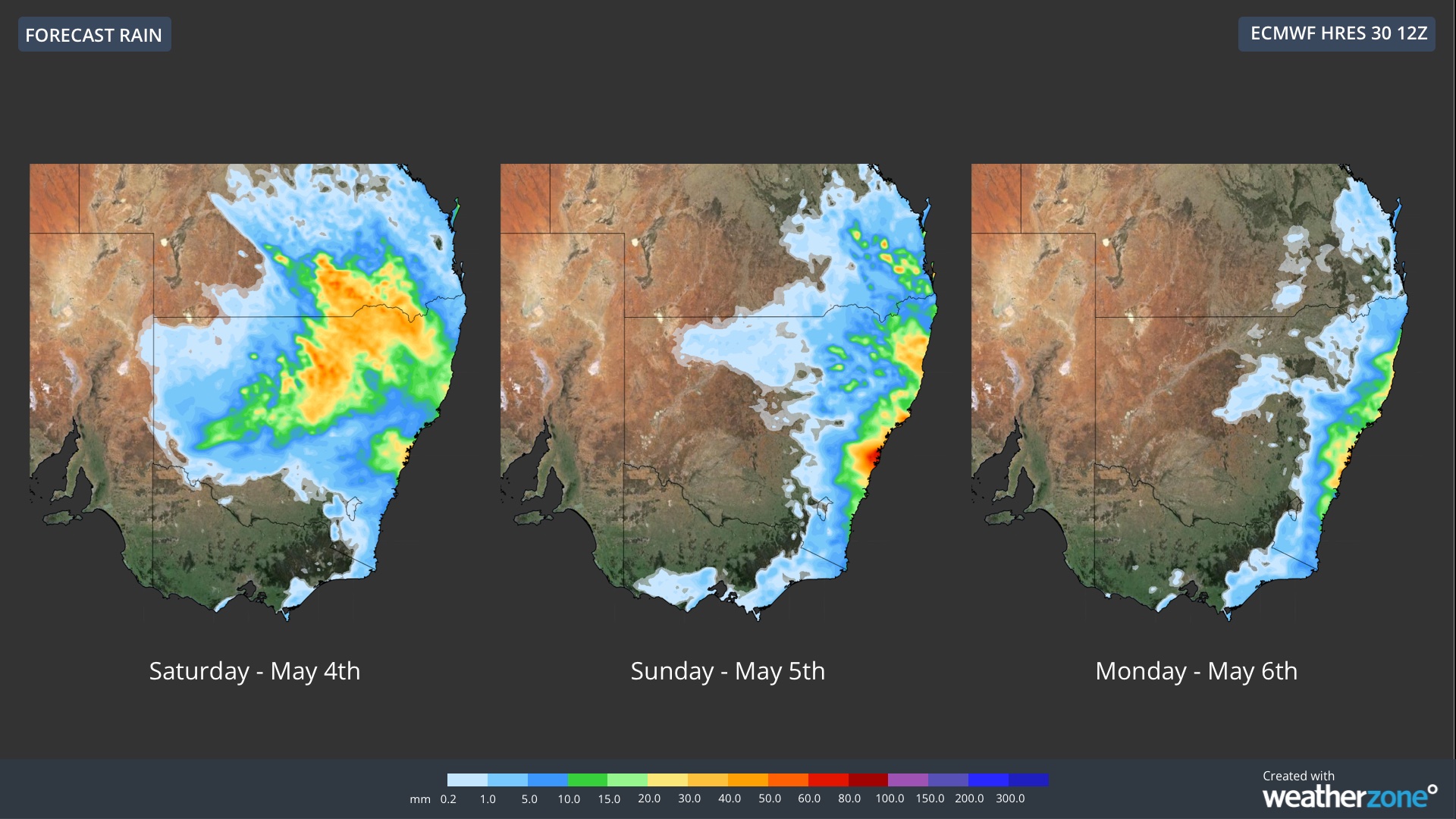
The map below shows one model’s daily rainfall forecast from Saturday, May 4 to Monday, May 6. 
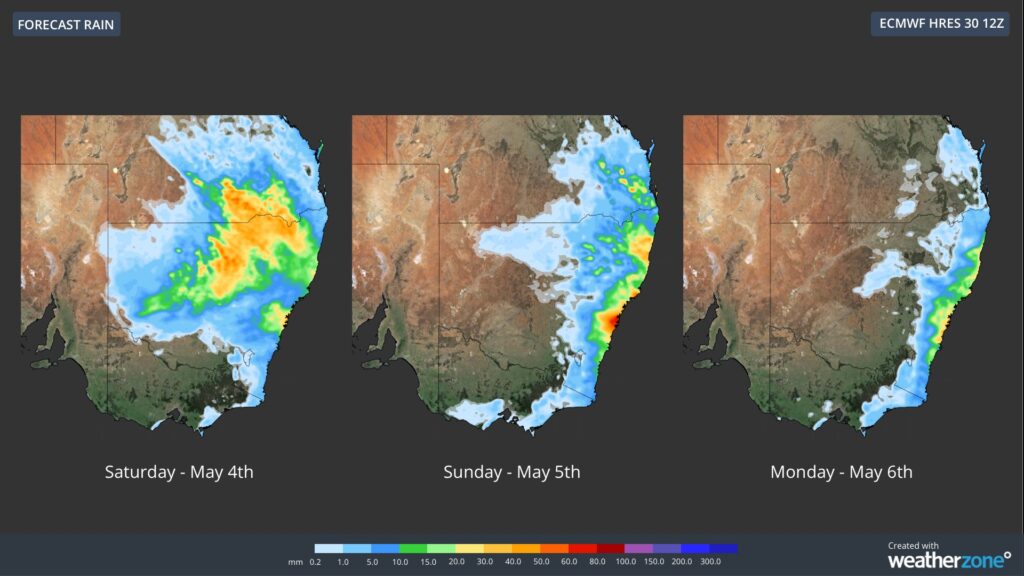
You can see that the largest daily totals are expected across central and northeastern NSW and southern Qld on Saturday, including some high totals in NSW’s west. 

The rainfall will then focus on eastern NSW and southeastern Qld on Sunday and Monday, with the heaviest falls along the central and northern NSW coastline on Sunday. 

This rainfall could cause flooding in NSW and southern Qld during this period, with this rainfall as it falls on a sodden landscape from the wet days preceding it.  

Visualise adverse conditions affecting your network with Stormtracker, our powerful GIS mapping system. Multiple weather and alert layers animate over your infrastructure and operating regions. Full-screen mode serves large control room monitors, whilst hyperlocal alerting provides real-time communication of weather and environmental threats. For more information, please contact us at apac.sales@dtn.com.


Latest news

Satisfy your weather obsession with these news headlines from around the nation, and the world.

Rapid El Niño signal accelerating risk for Australian businesses

El Niño–favourable conditions are gathering pace across the tropical Pacific, with key ocean indicators approaching threshold levels and early atmospheric responses emerging.  While uncertainty remains around final El Niño strength, historical analogues show that even weak events can generate widespread impacts, including reduced rainfall, warmer daytime temperatures, increased frost risk, elevated fire danger, reduced tropical cyclone activity, and more. Industries including […]

Australia’s 2025–26 Cyclone Season: Slightly Above Average, Dominated by Severe Systems

Australia has just experienced a highly impactful tropical cyclone season, with more than 60% of systems reaching severe intensity, causing widespread disruption and damage to communities and multiple industries across northern Australia.  The 2025–26 Australian tropical cyclone season officially ran from 1 November 2025 to 30 April 2026. During this six-month period, Australia saw 11 tropical cyclones, with nine […]

What does a ‘super El Niño’ mean for Australia’s businesses?

There are signs that a very strong, or ‘super’ El Niño could develop in the tropical Pacific Ocean later this year. So, what does this mean for Australia’s weather during the second half of 2026? El Niño on the horizon The tropical Pacific Ocean is currently in a neutral state, meaning neither El Niño nor […]

How does DTN help businesses monitor bushfire induced pyrocumulonimbus thunderstorms that ignite more fires?

Intense heat from bushfires during elevated fire danger days can trigger fire-induced pyrocumulonimbus thunderstorms that ignite additional fires. In early January 2026, an extreme heatwave sweeping over southeastern Australia brought catastrophic fire danger to Victoria. Intensely hot bush and grass fires spread erratically and quickly in hot, dry and gusty winds, with pyrocumulonimbus generating lightning, […]

