
Prosper in a dynamic world
Search

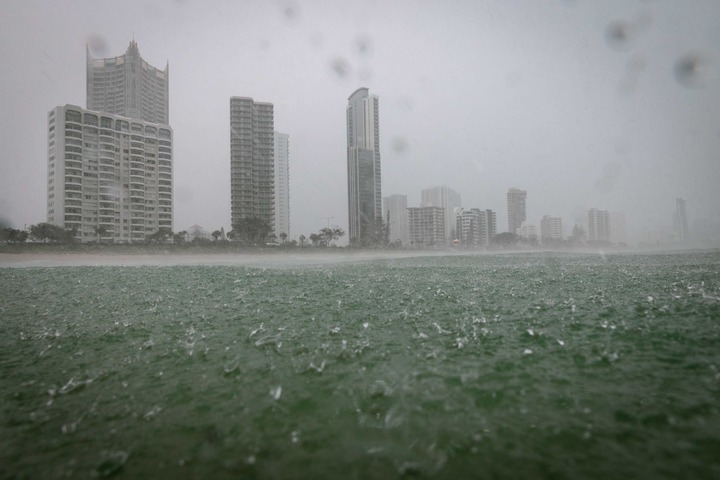
One month’s rain soaks Gold Coast overnight

Parts of southeast Qld just received more than a month’s worth of rain in 24 hours, with some areas on the Gold Coast collecting around 100 mm in six hours overnight.

A low pressure trough and developing low pressure system produced thick clouds and widespread rain across southeast Qld and northeast NSW during Monday night into Tuesday morning.

Video: Radar imagery showing observed rainfall over southeast Qld and northeast NSW between Monday afternoon and Tuesday morning.

Most places to the east of a line from Gympie to Goondiwindi and north of Lismore received 30 to 80 mm of rain during the 24 hours to 9am on Tuesday.

A focussed area of heavy rain inundated the Gold Coast and Tweed Coast and adjacent hinterland, where numerous rain gauges received 100 to 150 mm during this period.

The heaviest falls during the 24 hours ending at 9am on Tuesday included 168 mm at Loder Creek Dam, 158 mm at Molendinar and 151 mm at Biggera Ck Dam.

Coolangatta’s 117 mm in this period was its heaviest daily total in May since 1990. The Gold Coast Seaway also picked up 116 mm to 9am on Tuesday, its wettest May day since 2003.

On the NSW side of the border, Byron Bay’s 53.2 mm up to 9am Tuesday was half a month’s worth of rain for this time of year.

While rain has been intense in some areas, this is only a short-lived event. Drier weather had already returned to most areas of southeast Qld and northeast NSW by Tuesday morning and the last of the rain should clear off the coast by the afternoon.

DTN APAC’s meteorologists can provide special, short-notice weather briefings when severe weather is expected for your business, explaining what will happen and its impact on you business. To find out more, please email us at apac.sales@dtn.com.


Latest news

Satisfy your weather obsession with these news headlines from around the nation, and the world.

The 2026 Indian Southwest Monsoon onset is expected in the next two weeks

The Indian Southwest Monsoon will reach India in the next two weeks, but a developing El Niño could signal a drier than normal monsoon for businesses and major industries across the country. Southwest monsoon onset over southern India in the next two weeks The Indian Meteorological Department (IMD) is responsible for tracking the advance and […]

Rapid El Niño signal accelerating risk for Australian businesses

El Niño–favourable conditions are gathering pace across the tropical Pacific, with key ocean indicators approaching threshold levels and early atmospheric responses emerging.  While uncertainty remains around final El Niño strength, historical analogues show that even weak events can generate widespread impacts, including reduced rainfall, warmer daytime temperatures, increased frost risk, elevated fire danger, reduced tropical cyclone activity, and more. Industries including […]

Australia’s 2025–26 Cyclone Season: Slightly Above Average, Dominated by Severe Systems

Australia has just experienced a highly impactful tropical cyclone season, with more than 60% of systems reaching severe intensity, causing widespread disruption and damage to communities and multiple industries across northern Australia.  The 2025–26 Australian tropical cyclone season officially ran from 1 November 2025 to 30 April 2026. During this six-month period, Australia saw 11 tropical cyclones, with nine […]

What does a ‘super El Niño’ mean for Australia’s businesses?

There are signs that a very strong, or ‘super’ El Niño could develop in the tropical Pacific Ocean later this year. So, what does this mean for Australia’s weather during the second half of 2026? El Niño on the horizon The tropical Pacific Ocean is currently in a neutral state, meaning neither El Niño nor […]

