
Prosper in a dynamic world
Search

Negative IOD loosening grip on Australia

The negative Indian Ocean Dipole, one of the main climate drivers that underpinned Australia’s second wettest October on record, is likely nearing its end.

The Indian Ocean Dipole (IOD) is an index that measures sea surface temperature anomalies in the tropical Indian Ocean.

A negative IOD occurs when warmer-than-average water builds up to the northwest of Australia, near Indonesia, and cooler-than-average water lies in the western tropical Indian Ocean, near the Horn of Africa.

This contrast in sea surface temperatures across the tropical Indian Ocean causes more moisture-laden air to flow towards Australia, which fuels above-average rainfall.
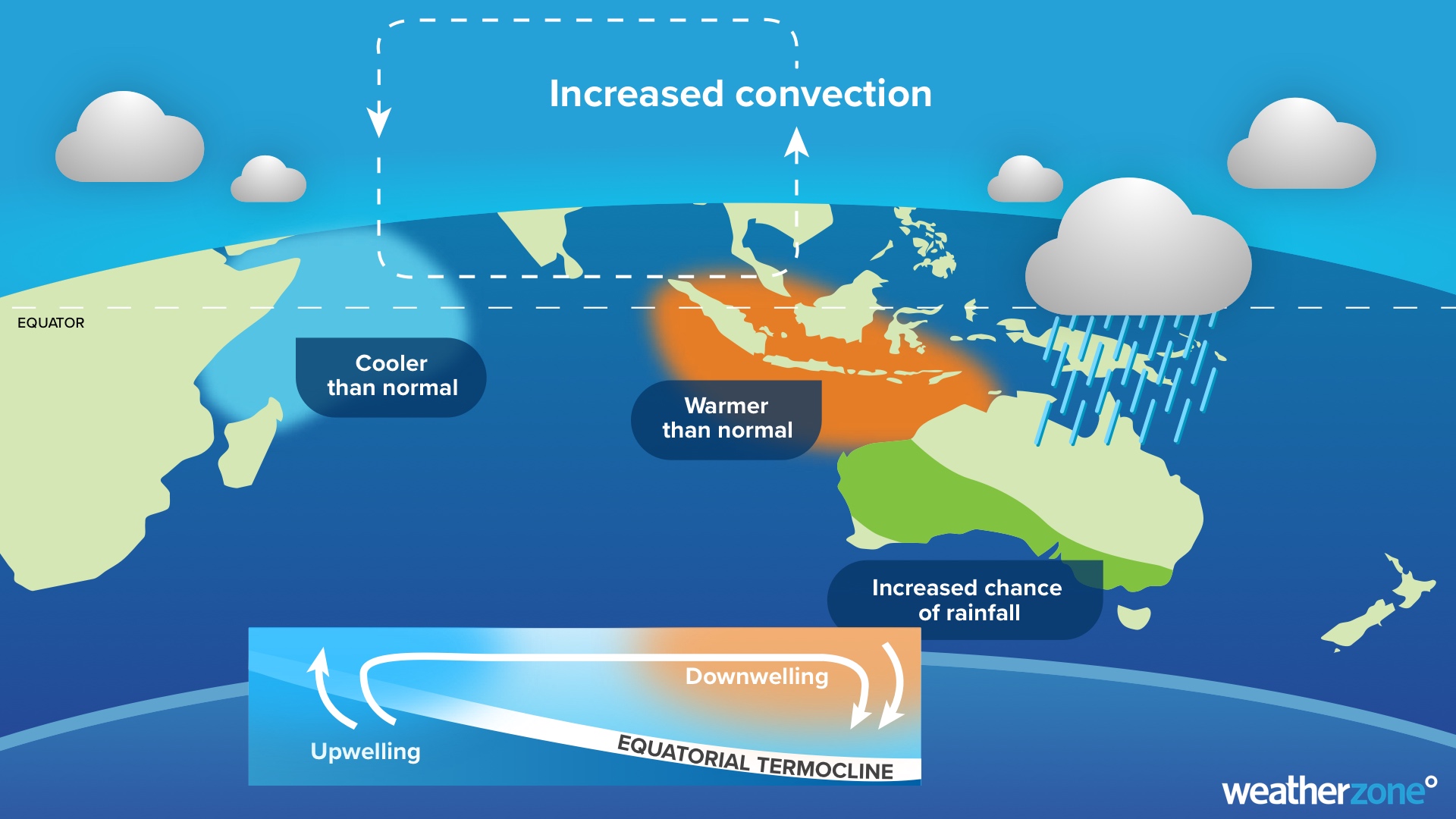
Image: The typical ocean and atmospheric states during a Negative Indian Ocean Dipole (IOD).

This year’s negative IOD was officially declared in August and is still underway, according to the Bureau of Meteorology. During this time, Australia has registered its 2nd wettest October and 5th wettest September in 123 years of records.

However, the IOD has shown signs of weakening over the past few weeks, with the latest weekly IOD index value returning to the neutral range (between –0.4ºC and +0.4ºC) for the first time in five months.
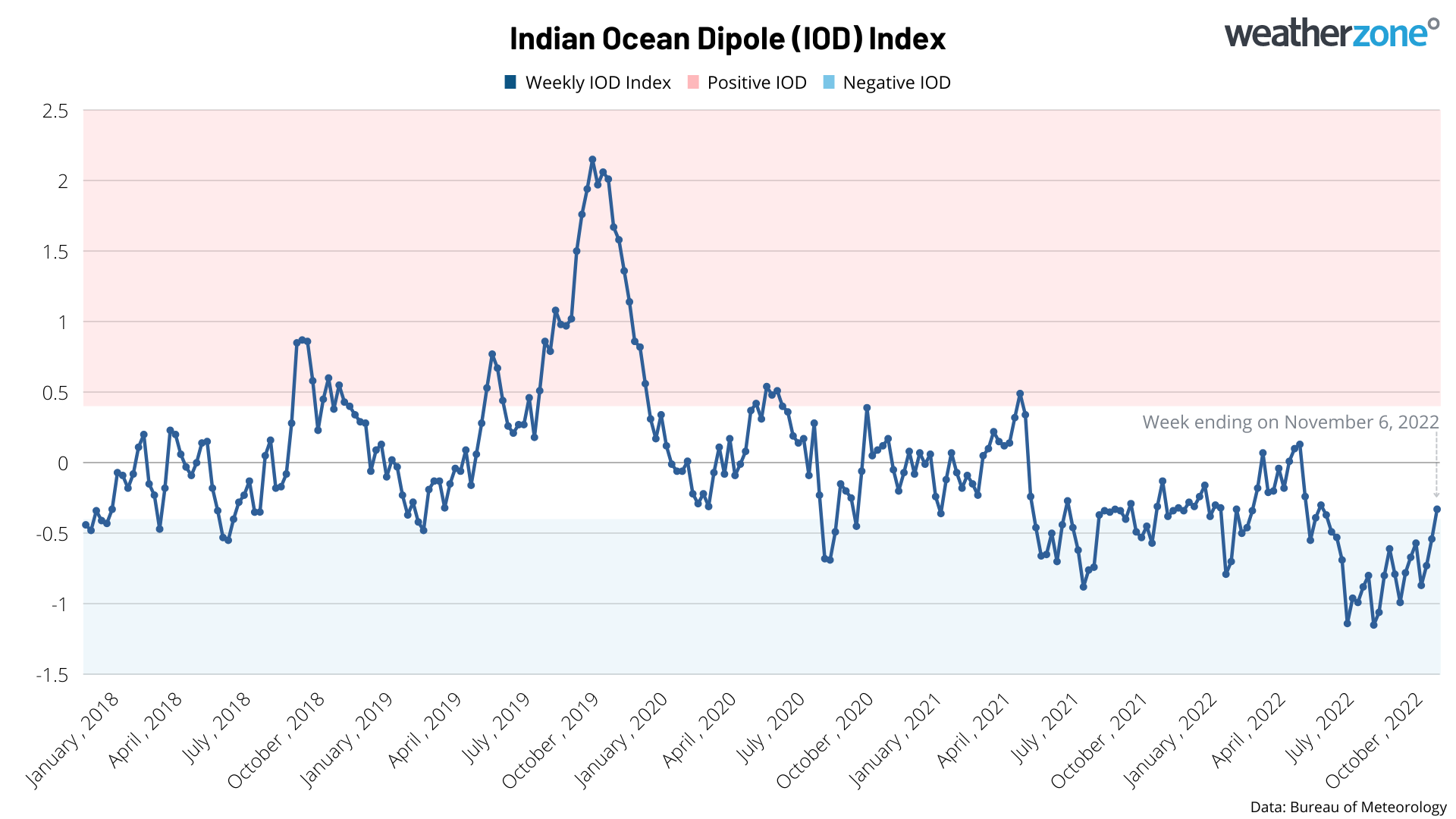
Image: Weekly IOD index values during the past few years.

This weakening of the IOD index over the past few weeks is a clear sign that the 2022 negative IOD episode is nearing its end, despite the atmosphere above the Indian Ocean remaining in a negative IOD-like state. All forecast models surveyed by the Bureau predict that the IOD will be in a neutral state by December.

In the absence of the negative IOD, the likelihood of above-average rain will lessen from December over parts of western and southern Australia. However, wetter-than-average conditions will remain an elevated risk in eastern Australia, due to the ongoing influence of La Niña and a predominantly positive Southern Annular Mode (SAM).
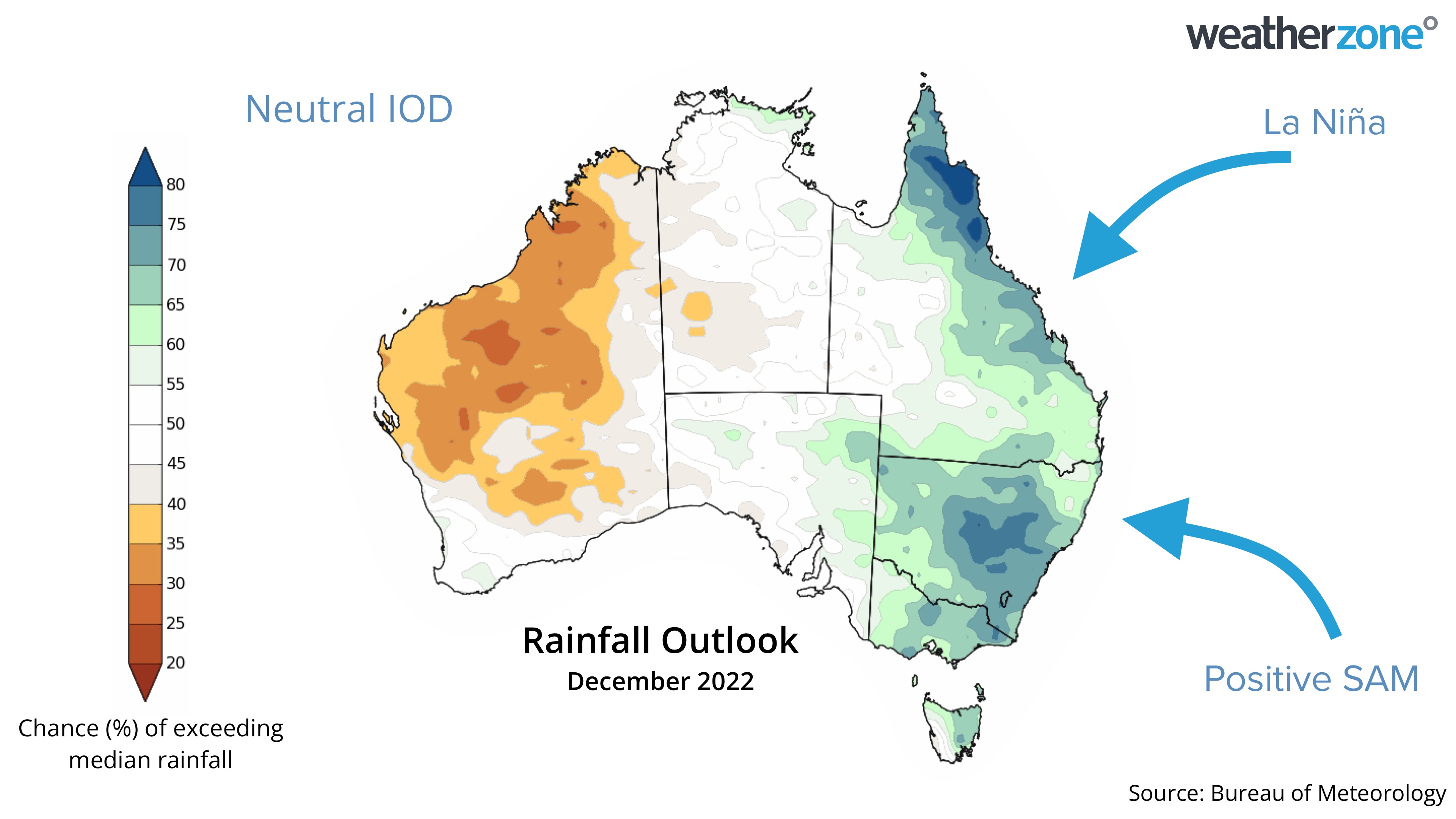
Image: Rainfall outlook for December 2022. Source: Bureau of Meteorology.


Latest news

Satisfy your weather obsession with these news headlines from around the nation, and the world.

Australia’s 2025–26 Cyclone Season: Slightly Above Average, Dominated by Severe Systems

Australia has just experienced a highly impactful tropical cyclone season, with more than 60% of systems reaching severe intensity, causing widespread disruption and damage to communities and multiple industries across northern Australia.  The 2025–26 Australian tropical cyclone season officially ran from 1 November 2025 to 30 April 2026. During this six-month period, Australia saw 11 tropical cyclones, with nine […]

What does a ‘super El Niño’ mean for Australia’s businesses?

There are signs that a very strong, or ‘super’ El Niño could develop in the tropical Pacific Ocean later this year. So, what does this mean for Australia’s weather during the second half of 2026? El Niño on the horizon The tropical Pacific Ocean is currently in a neutral state, meaning neither El Niño nor […]

How does DTN help businesses monitor bushfire induced pyrocumulonimbus thunderstorms that ignite more fires?

Intense heat from bushfires during elevated fire danger days can trigger fire-induced pyrocumulonimbus thunderstorms that ignite additional fires. In early January 2026, an extreme heatwave sweeping over southeastern Australia brought catastrophic fire danger to Victoria. Intensely hot bush and grass fires spread erratically and quickly in hot, dry and gusty winds, with pyrocumulonimbus generating lightning, […]

Active seas to the north and east of Australia disrupting port and maritime operations

Seas to the north and east of Australia are experiencing periods of increased activity this week, leading to disruptions to port, maritime and offshore operations. Intense and hazardous Tasman Sea Ocean conditions across NSW’s South Coast rapidly deteriorated last Friday as a deep feed of easterly winds whipped up large and dangerous seas. The Batemans […]

