

Prosper in a dynamic world
Search

Canberra breaks October rainfall record

We’ve seen no shortage of places across the eastern half of Australia break their rainfall record this soggy October, and the nation’s capital is the latest.

  • Weather records have been kept in Canberra since 1939, and the old record for the wettest October was 161 mm in 1976.
  • To 9 am on Thursday morning, the monthly tally for October 2022 was sitting on 160 mm, but a heavy burst of rain during the early afternoon delivered 3.4 mm by 3 pm.
  • That brought the monthly tally for October to a record 163.4 mm.
  • For the record, Canberra’s rainfall tends to be reasonably evenly distributed throughout the year, but October is on average the city’s second-wettest month with an average of 62.4 mm. So it is heading towards triple its monthly average.
  • It’s also worth mentioning that Canberra’s rainfall to date for 2022 was 739 mm as at 9 am this morning, which means it is now sitting on 742.4 mm as we write this story on Thursday afternoon.
  • The long-term annual average rainfall is 615.4 mm, so Canberra is again looking at a much wetter year than usual. The wettest year on record was 1950 with 1062.5 mm.

Meanwhile, after such a wet year to date, and with significantly above-average monthly rainfall in both August and September, it’s little wonder that the lawns of the bush capital and its nearby hills are looking especially green right now.
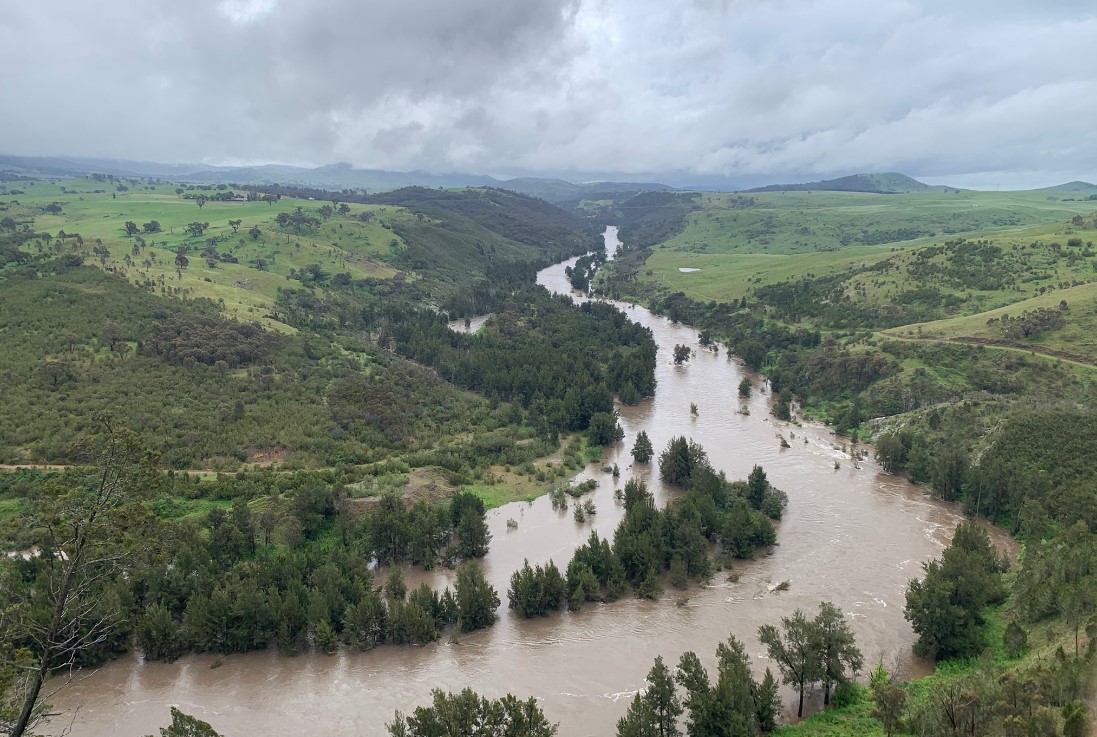
Image: The Murrumbidgee River just west of Canberra from Shepherds Lookout. Source: Patrick Tobin.

The local wildlife has also been snapped looking somewhat miserable during heavier downpours!

Image: Maggie here is not the only Canberran who is sick of getting wet. Source: Maria Del’Amore.

More rain is in store for Canberra this month, with showers likely on each day of the remainder of October except for Saturday.

To find out more about Weatherzone’s weather and climate products, please email apac.sales@dtn.com.

Latest news

Satisfy your weather obsession with these news headlines from around the nation, and the world.

Australia’s 2025–26 Cyclone Season: Slightly Above Average, Dominated by Severe Systems

Australia has just experienced a highly impactful tropical cyclone season, with more than 60% of systems reaching severe intensity, causing widespread disruption and damage to communities and multiple industries across northern Australia.  The 2025–26 Australian tropical cyclone season officially ran from 1 November 2025 to 30 April 2026. During this six-month period, Australia saw 11 tropical cyclones, with nine […]

What does a ‘super El Niño’ mean for Australia’s businesses?

There are signs that a very strong, or ‘super’ El Niño could develop in the tropical Pacific Ocean later this year. So, what does this mean for Australia’s weather during the second half of 2026? El Niño on the horizon The tropical Pacific Ocean is currently in a neutral state, meaning neither El Niño nor […]

How does DTN help businesses monitor bushfire induced pyrocumulonimbus thunderstorms that ignite more fires?

Intense heat from bushfires during elevated fire danger days can trigger fire-induced pyrocumulonimbus thunderstorms that ignite additional fires. In early January 2026, an extreme heatwave sweeping over southeastern Australia brought catastrophic fire danger to Victoria. Intensely hot bush and grass fires spread erratically and quickly in hot, dry and gusty winds, with pyrocumulonimbus generating lightning, […]

Active seas to the north and east of Australia disrupting port and maritime operations

Seas to the north and east of Australia are experiencing periods of increased activity this week, leading to disruptions to port, maritime and offshore operations. Intense and hazardous Tasman Sea Ocean conditions across NSW’s South Coast rapidly deteriorated last Friday as a deep feed of easterly winds whipped up large and dangerous seas. The Batemans […]


