
Prosper in a dynamic world
Search

Is there a lack of radar coverage at your location? Oracle can help fill the gaps.


Radar coverage is sparse across regional Australia, much to the frustration of miners and local communities. This is because radars are typically placed near the coast, where much of Australia lives. Unfortunately, they can only detect rainfall within a 256 kilometre radius, leaving many areas without coverage.

Significant rainfall was observed in the Pilbara last week, which was not covered by your stock standard radar. The holes in the coverage through regional Western Australia are noticeably clear.


Weatherzone has the solution, and its name is Oracle.

Oracle is a new ‘radar’ system, which enables users to see rain as its happening anywhere in the world. In addition to tracking current rain, Oracle also provides live forecasts of rainfall rates, lightning, and cloud for up to three hours in advance, for anywhere in the world.

It does this by feeding live satellite imagery, lightning data and nearby radar imagery into the forecast system. This cutting-edge technology was built in collaboration with Solcast.

Oracle certainly hit the nail on the head last week, with Oracle rainfall rates of 40mm/hr shown near the Tom Price area (yellow shade figure 2).

But how did this compare to the rainfall observed on the ground at weather stations?

Rainfall observation sites on the ground near Tom Price, WA, have received between 39-41mm in the 24 hours leading up to 9am last Wednesday, 5 May (boxes with rainfall observation numbers in figure 2).
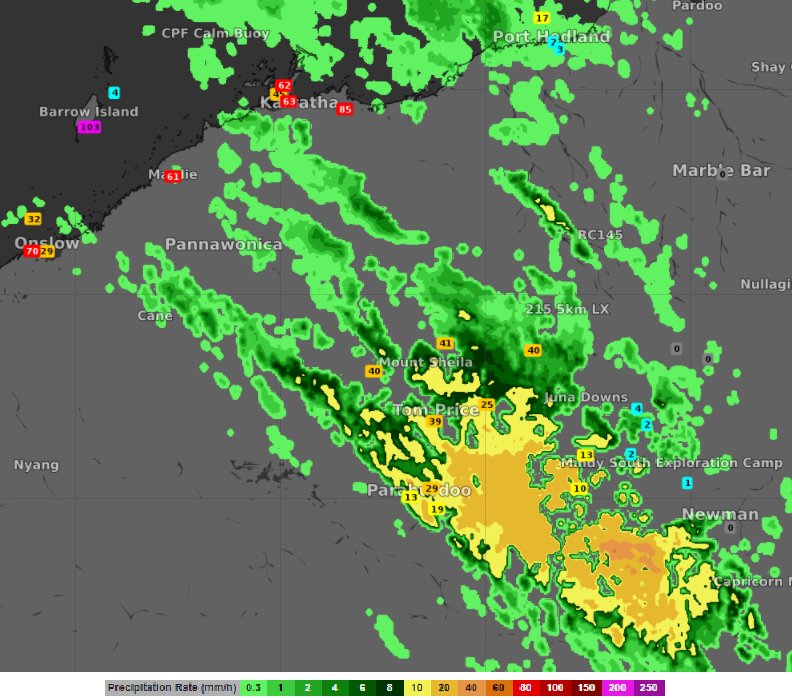
 

Figure 2: Oracle observed rainfall rates (shading) on Wednesday 5 May 8:05am (am or pm) WST. The boxes with numbers are rainfall observations since 9am on the 4 May.

Oracle is a more than adequate replacement for radar, but the genius of it is also a one-of-a-kind forecast system, delivering accurate forecasts out to 4 hours. Stay tuned for additional updates on Oracles new forecasting capabilities. For more information, please contact us at apac.sales@dtn.com.


Latest news

Satisfy your weather obsession with these news headlines from around the nation, and the world.

El Niño Is Here: What a Potential Record Event Means for Southeast Asia and Australia

  El Niño was officially declared in June 2026, raising the prospect of widespread impacts across Southeast Asia, from extreme heat and water shortages to higher energy demand and agricultural stress.   The World Meteorological Organization has warned countries to “prepare for it to be severe”, while several global forecast models suggest the event could rank among […]

How El Niño will shape Australian port operations in winter-spring 2026

Australian ports and marine pilots can expect a season of shifting wind and swell patterns through winter and spring 2026, as a developing El Niño brings the likelihood of drier conditions and more variable operating windows across the country’s coastline.  Will El Niño develop in 2026?  There are clear signs that an El Niño pattern is becoming […]

From Kimberley to northern NSW: Bushfire outlook flags risk for resources sector this winter

Bushfire risk doesn’t usually make headlines in June, but AFAC’s winter seasonal outlook is putting mining and resources operators on alert from the Kimberley to the NSW.  Australia’s official seasonal bushfire outlook for winter 2026 was released by AFAC on Thursday, May 28. The outlook predicts increased fire risk across the northern parts of the Great Sandy Desert and surrounds […]

The signal was there weeks earlier: forecasting one of the year’s biggest wind events

In mid-May 2026, DTN APAC meteorologists flagged a strengthening Southern Ocean pattern in model guidance, signalling an extended run of record-challenging wind conditions across the NEM.  Nearly three weeks later, NEM wind generation climbed from around 1.5GW to more than 9GW, supplying roughly one-third of the grid and coming within 1GW of the all-time generation record.  The event highlighted […]

