
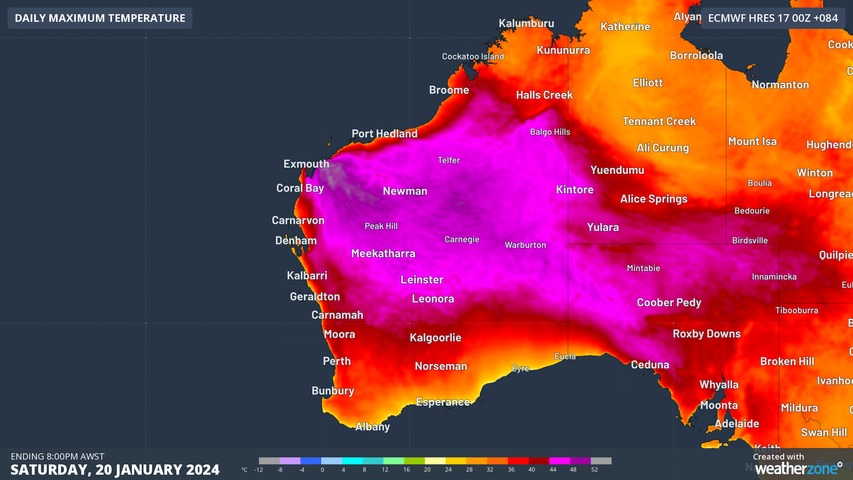
The presence of multiple tropical lows in the Australian region could cause a burst of intense heat over the Pilbara this weekend and early next week, with temperatures possibly exceeding 50ºC in some areas.
Northwestern Australia is always hot in early summer as temperatures soar amid abundant pre-monsoon sunshine. The mercury frequently reaches the mid-forties during January and has even exceeded 50ºC on rare occasions.

Image: Onslow, WA. This Pilbara town reached 50.7ºC in January 2023, equalling the Australian record.
Under certain circumstances, the Pilbara has the potential to produce some of the highest temperatures in the world and unfortunately for locals, one of these extreme heat-inducing weather patterns could occur over the coming week.
A mass of very hot air is likely to be drawn into the Pilbara region from this weekend by a deepening low pressure trough. This air mass has the potential to be hotter than usual, even by the Pilbara’s standards, due to enhanced warming from a phenomenon called subsidence.
Subsidence occurs in the atmosphere when air descends over a broad area, causing it to become warmer as it sinks to lower levels. In this case, the subsidence will be triggered by winds converging high above WA, thanks to upper-level air flowing away from two tropical lows in the Australian region.
Some forecast models suggest that subsidence-induced heating could see temperatures exceed 50ºC in parts of the Pilbara this weekend or early next week, most likely at some point between Saturday and Tuesday.

Image: Forecast maximum temperature on Saturday, January 20, according to the ECMWF-HRES model.
It’s worth pointing out that there is a fair amount of model uncertainty regarding weather patterns over the Australian region in the coming week, largely due to the presence of three tropical lows/cyclones.
If the mercury does exceed 50ºC in the Pilbara, all eyes will be on Australia’s national record of 50.7ºC, which was last reached at Onslow on January 13, 2023. Australia has only registered official temperatures above 50ºC on seven occasions.
To find out more about our Mining Services, lightning alerting, or bushfire services, please email us at apac.sales@dtn.com.




