Prosper in a dynamic world
Search

Perth set to scorch over the weekend


While you’d struggle to find a small patch of blue sky across eastern Australia, summer has arrived early in Perth. Perth’s maximum temperatures are expected to top 34°C on Friday, 37°C on Saturday and 33°C on Sunday.  

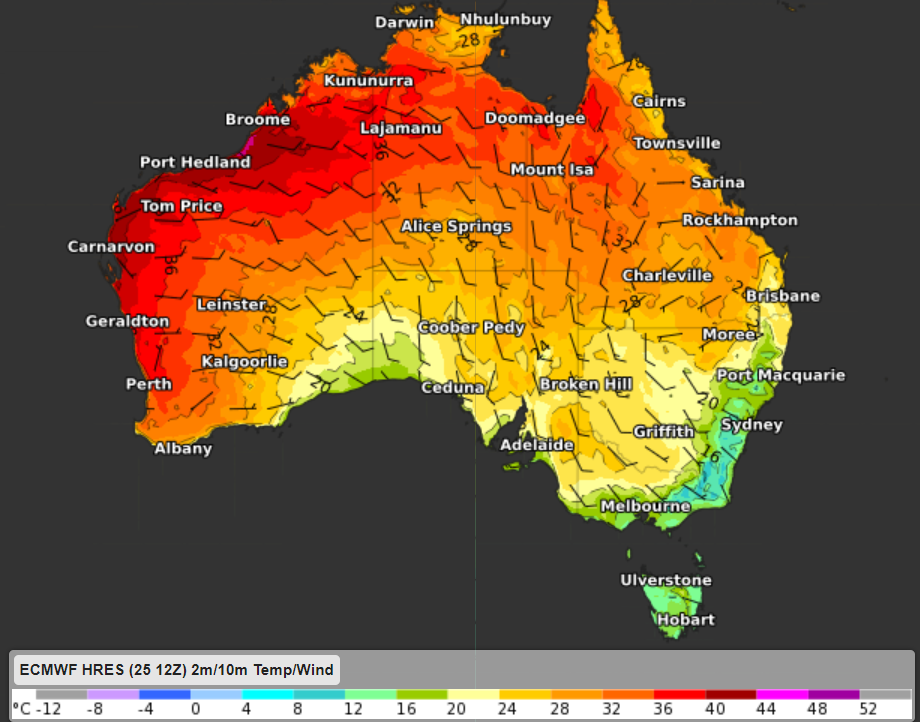
Saturday’s daytime temperature is expected to be 9-10°C above Novembers average, the hottest day in eight months (figure 1) 

 temp sat

Figure 1: ECMWF 2m temperature and 10m wind at 2pm WST on Saturday, November 27. 

When was the last time Perth was this hot and dry? 

  • The last time Perth reached or exceeded the mid-thirties was way back on March 29 this year, when the mercury peaked at 39.0°C. 
  • The hottest since then was October 15, 2021, when the mercury reached 33.2°C. 
  • As is typical for this time of year, Perth has started to dry out during November, after a super wet October, in which the city tripled its monthly average of 40.9 mm with 122.8 mm, and indeed broke the October rainfall record. 
  • While 40.4 mm of rain fell on November 9, that was just one of three ground-wetting days this month, and no rain is on the cards for the next week. 

So the big dry typical of a Perth summer is on its way, and while temperatures should dip back into the mid-to-high twenties early next week, the heat looks to peak this weekend. 

Why is the west coast warm and dry, while the east experiences a mild and wet summer during La Nina years? 

During La Nina years, high pressure over southern Australia is common, which for Perth means dry and hot easterly winds from the interior of Australia. These easterly winds promote warmer weather for Perth and the west coast (figure 1). 

While easterly winds across the east coast of Australia are humid, cool and produce rain and cloud as they hit the Great Dividing Range. 

Weatherzone’s model Opticast is an industry leader and can forecast maximum and minimum temperatures up to two weeks out, including confidence intervals and risk of extreme heat. For more information, please contact us at apac.sales@dtn.com. 
Latest news

Satisfy your weather obsession with these news headlines from around the nation, and the world.

Signs of a positive Indian Ocean Dipole, but it may not follow the textbook

Waters off Indonesia have cooled in recent weeks, an indication that a positive Indian Ocean Dipole (IOD) event could be developing. It’s an important climate driver for Australia, and it could shape rainfall and temperatures heading into summer, with flow-on effects for farmers, energy and other industries.  What is the Indian Ocean Dipole?  The IOD […]

1.3 million lightning strikes and a record September downpour: the storms testing WA’s Goldfields

Leonora, WA, had its wettest September day on record earlier this month. Three weeks later, more than 1.3 million lightning pulses were detected within 800 km of the town in 48 hours. Why is a stalled trough delivering storms to mining country, and what it could mean for operations?  The DTN Total Lightning Network detected […]

A very low wind power week, likely to continue

A stubborn blocking high over southern Australia will make for a very quiet week for wind generation and the pattern behind it isn’t a one-off.   It’s the seasonal signature of a super (very strong) El Niño combined with a positive Southern Annular Mode (SAM), and both the historical record and the current seasonal forecast suggest it’s likely to keep recurring through spring before a potential switch from November.  The setup right […]

Fastest strengthening El Niño on record: Impacts on Australian monsoon timing and wet season planning

Australia’s Mining and Resources sectors are bracing for a wet season shaped by one of the most rapidly developing El Niño events on record.    Looking back at how the strongest El Niño events in Australian history have played out, it becomes apparent that mining operations in Australia should be planning for a later monsoon […]