
A healthy 2025 Australian snow season will provide hydropower for the National Electricity Market (NEM) through the coming months.
As the lifts stopped turning across the Australian alps, the 2025 Australian snow season has proven to be a good year – with months of hydropower to be generated as the lingering snowbase melts. The season was not a remarkable one in historical terms, but a slightly above-average season in terms of peak snow depth.
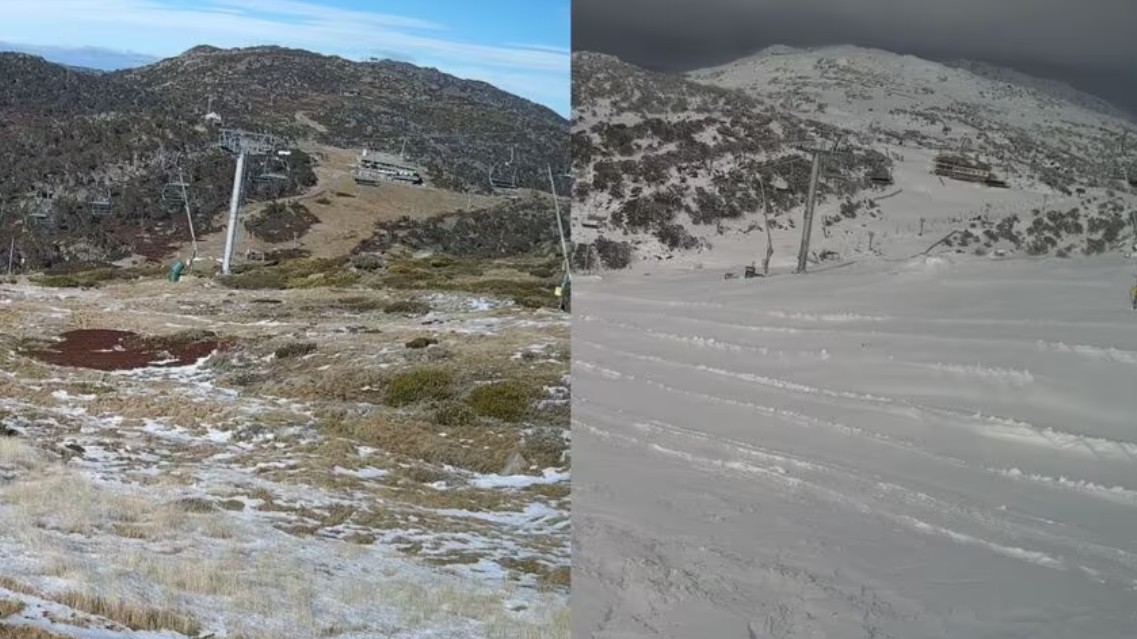
It was also a relatively long season by recent standards. The first big blizzard arrived just in time for the King’s Birthday long weekend opening in June. The impact of the big early-season snowstorm was captured in Weatherzone’s story that featured a series of before-and-after images.
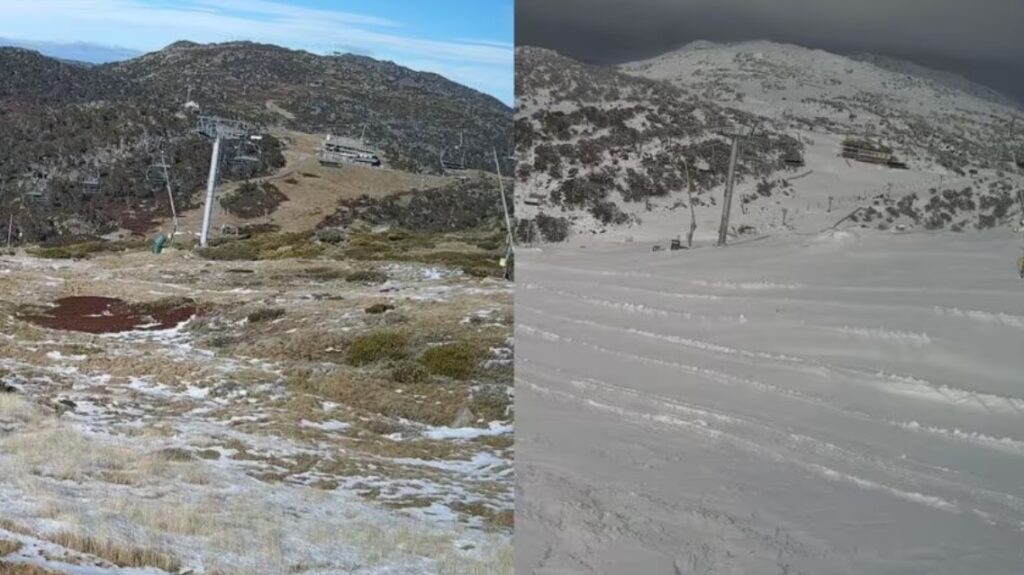
Image: The summit run at Mt Blue Cow, part of Perisher resort in NSW, before and after the long weekend blizzard in June 2025. Source: Perisher Resort
This season’s peak snow depth at Spencers Creek in NSW was 220.4cm on September 1.
Data has been collected by Snowy Hydro at Spencers Creek (at an elevation of 1830m, roughly halfway between Perisher and Thredbo) and at two lower sites since 1954. The average Spencers Creek season depth over the length of the data set is just under two metres.
So at high elevations, this season’s NSW snow depth exceeded the average. This was also true in Victoria, where Mt Hotham’s signature Heavenly Valley chairlift had its highest number of operational days in 25 years.
Lower down, it was a different story. Selwyn Snow Resort, the lowest commercial ski resort in NSW, had a mediocre season that ended in early September. So too did Victoria’s Mt Baw Baw, that state’s lowest ski hill.
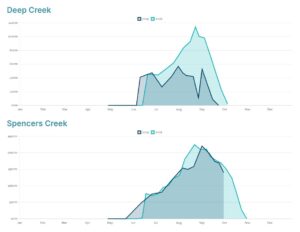
Image: Spencers Creek (dark blue) and Deep Creek (light blue) snow depths in 2025 vs 2018. Source: Snowy Hydro.
The graphs (above) show Spencers Creek and Deep Creek in NSW in 2025. The lower graph shows that the 2025 and 2018 seasons were similar in terms of both snow depth and season duration at Spencers Creek.
But at the Deep Creek snow measuring site, which is just 210m lower at an elevation of 1620m, the picture is very different. While Deep Creek topped a metre back in 2018, its peak depth barely rose above 50cm this season.
The 2004 graphs (below) paint the picture even more starkly. Again, the peak depth and season duration at Spencers Creek was similar in 2004 to 2025. But this year’s peak depth at the lower Deep Creek site was only about a third of the 2004 peak depth.
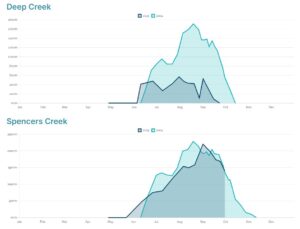
Image: Spencers Creek (dark blue) and Deep Creek (light blue) snow depths in 2025 vs 2004. Source: Snowy Hydro.
Fortunately, the warming trend which has impacted the lower parts of Australia’s alpine region has not yet taken a significant toll of snow cover at the highest elevations – providing longer lasting hydropower potential with more gradual snow melt across the elevations.
Meanwhile the most recent Snowy Hydro reading at Spencers Creek for the 2025 season was 139.9cm on September 30.
How DTN APAC services the hydropower industry
Using Opticast’s nowcasting and forecasting capabilities, you will have long-term outlook covering rainfall and extreme heat events out to 12 months. This can significantly improve your planning as you integrate the data with site-specific hydrological parameters.
DTN APAC’s Opticast is an ultra-local forecasting system, independently proven to be the best performing of its type in Australia. Providing an unprecedented level of accuracy and precision, Opticast rapidly updates every 10 minutes, intelligently adapting to local observations, and corrects forecasts based on historical evidence. Wherever you are based, we can provide you with the most accurate nowcasting and forecasting data out to 14 days so that you can mitigate operational and safety risks, and plan to make the most of severe weather windows.
With renewables making up more of Australia’s energy mix every year, we want to support your business to make informed critical decisions and improve your overall generation and safety.
Learn more about our large range of industry leading products and services or email us at sales.apac@dtn.com




