

Several natural and human-made influences combined forces across Earth last month, creating a ‘perfect climate storm’ that made July 2023 Earth’s warmest month on record.
Recently published data from Berkeley Earth shows that Earth’s global average temperature in July was 17.2ºC, which is 1.54ºC above the 1850 to 1900 average. This was the highest global temperature on record for any month, and the first calendar month to exceed 17.0ºC since records began in 1850.

Image: Global average monthly temperatures between 1850 and 2023, according to data from Berkeley Earth.
The exceptionally high global average temperature in July was caused by abnormal warmth across most of Earth’s oceans and land masses. Only a few small pockets of the plant were cooler than average in July 2023.
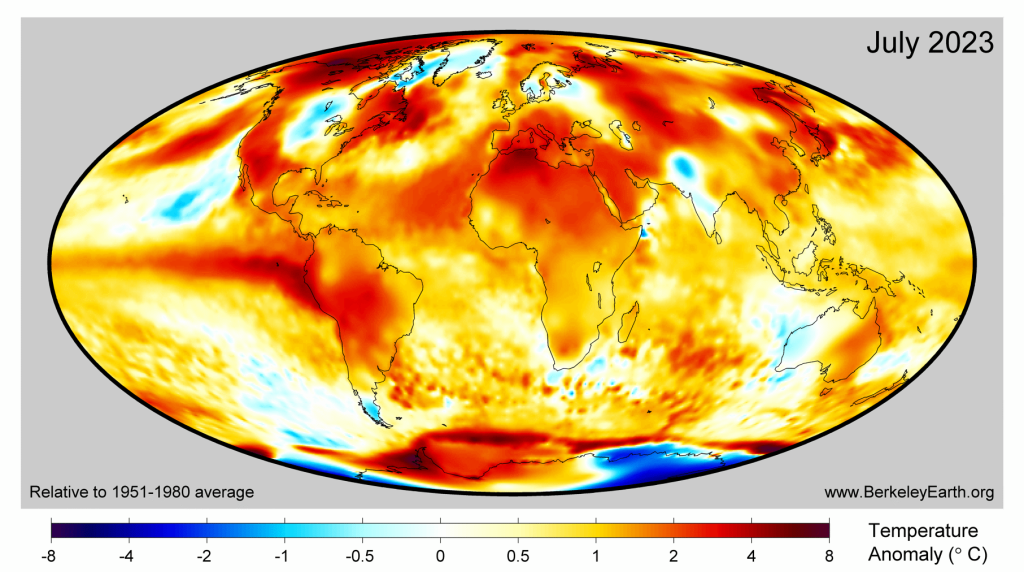 Image: Temperature anomalies during July 2023. Source: Berkeley Earth
Whay was July so warm?
According to Berkeley Earth, last month’s unrivalled global average temperature was caused by a range of natural and human-made factors.
Climate Change
The global average temperature has been gradually increasing in recent decades, primarily in response to increasing concentrations of atmospheric greenhouse gases from human activities. This anthropogenic global warming is causing Earth’s temperature to rise by about 0.19ºC per decade.
El Niño
A developing El Niño has caused a large pool of unusually warm water to build up at the surface of the tropical Pacific Ocean in the middle of 2023. This oceanic warming from El Niño is known to increase global average temperatures, and the developing El Niño is likely to have played a big role in July’s record global warmth.
Water temperatures were also much warmer than average in parts of the North Pacific and North Atlantic Oceans during July.
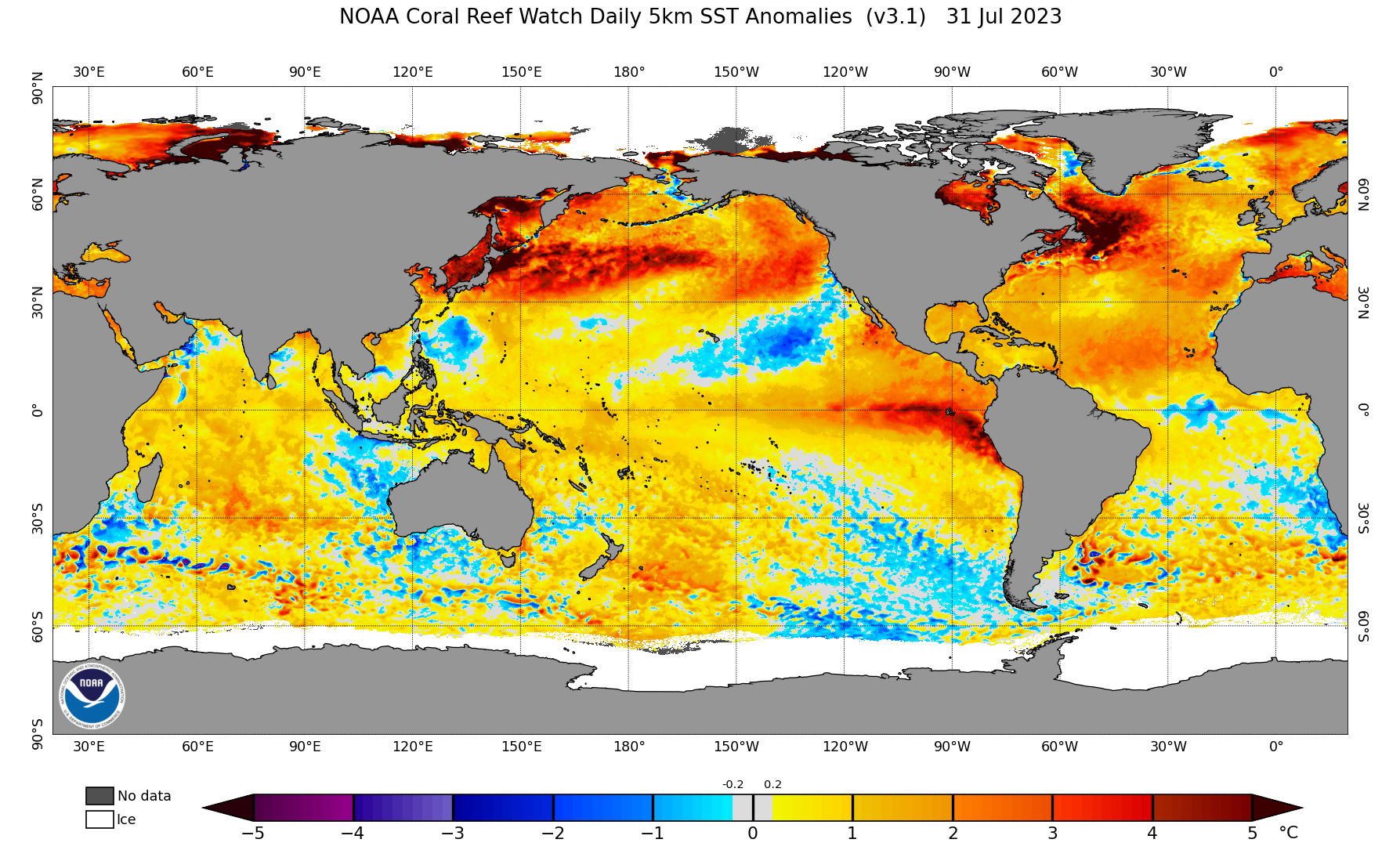
Image: Global sea surface temperature anomalies at the end of July 2023. Source: NOAA
Solar activity
Our Sun has an 11-year cycle of increasing and decreasing solar activity. These solar cycles have a small influence on how much radiation Earth receives from the sun, and the peak of the current solar cycle will occur in 2024 or 2025.
Tonga volcano
A huge amount of water vapour that was ejected into Earth’s atmosphere by the Hunga Tonga–Hunga Haʻapai volcanic eruption in January 2022. This water vapour is likely to linger in the stratosphere for years and while its influence on Earth’s atmosphere is still an area of active research, some studies suggest that it is contributing to warming near surface.
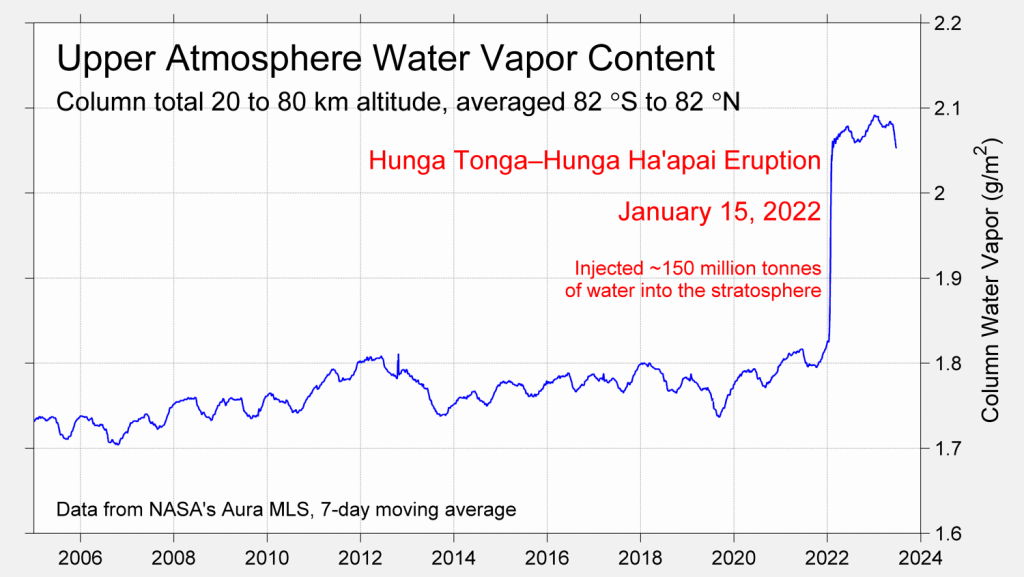
Image: Water vapour in the upper atmosphere increased rapidly in response to the Hunga Tonga–Hunga Haʻapai eruption in January 2022. Source: Berkeley Earth.
According to Berkeley Earth, “global warming and El Niño are the primary factors responsible for the present high temperatures.”
However, there were a number of other influences that helped cause the record high global temperature in July 2023. This unprecedented month highlights how the background warming from climate change can be either suppressed or exacerbated by other natural and human-made influences.




