Prosper in a dynamic world
Search

Unusually stormy summer for Australia, lightning data shows

Large areas of Australia saw an above average number of lightning days this summer, with Melbourne, Canberra and Brisbane all seeing 5 to 6 extra storm days during the season.

Australia always sees lots of lightning during summer as hot air, abundant moisture and ample atmospheric instability combine to create ideal conditions for thunderstorms.

The map below shows the average number of thunder days in Australia during summer, based on all lightning detected by Total Lightning Network between 2014 and 2024. Storm days are defined as any day where lightning is detected close enough to cause audible thunder.
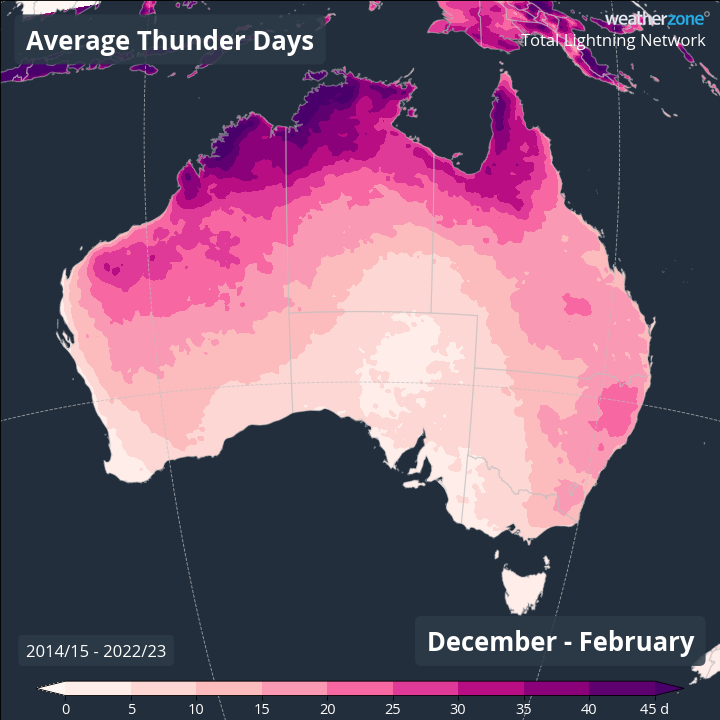
Image: Average number of thunder days in Australia during summer, based on lightning detected by Total Lightning Network (TLN) between 2014 and 2024.

In an average summer, northern and eastern Australia typically see the highest number of thunder days. There is a noticeable peak over the western Top End and Kimberley regions, with Darwin averaging around 47 thunder days per summer.

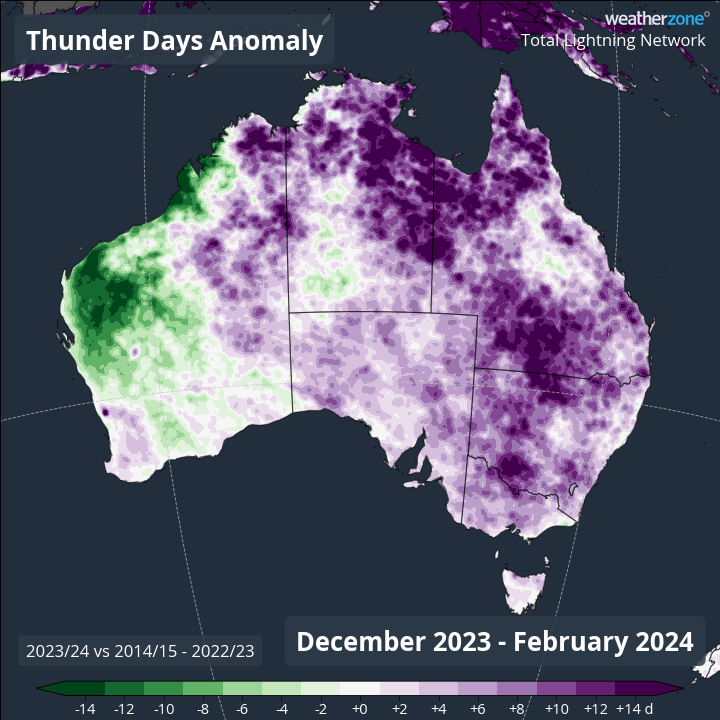
This summer saw an unusually high number of thunder days Australia’s central and eastern tropics and over most of Qld, NSW, SA, Vic, the ACT and Tas. By contrast, there were less thunder days than normal over large areas of WA and pockets of central Australia and central Qld. The maps below show the observed thunder days this summer and the correlating anomalies for the season.
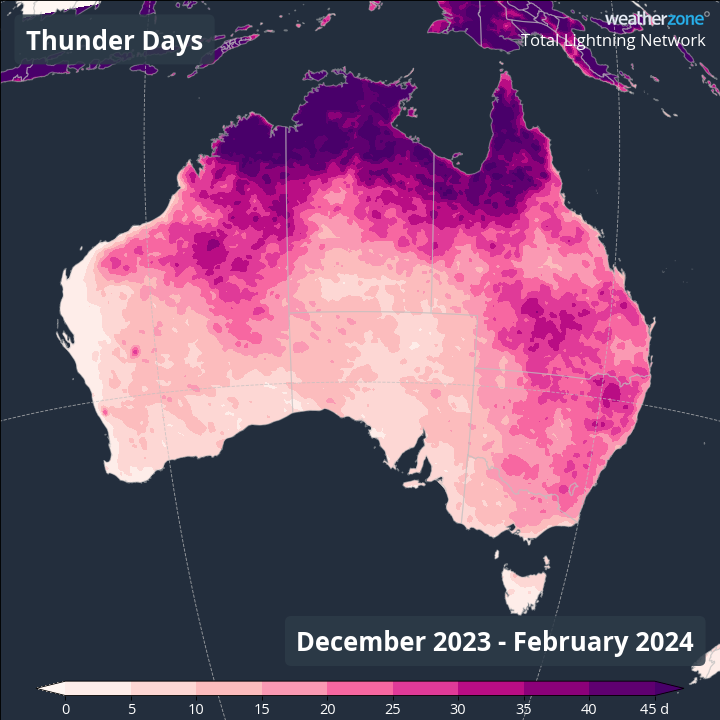
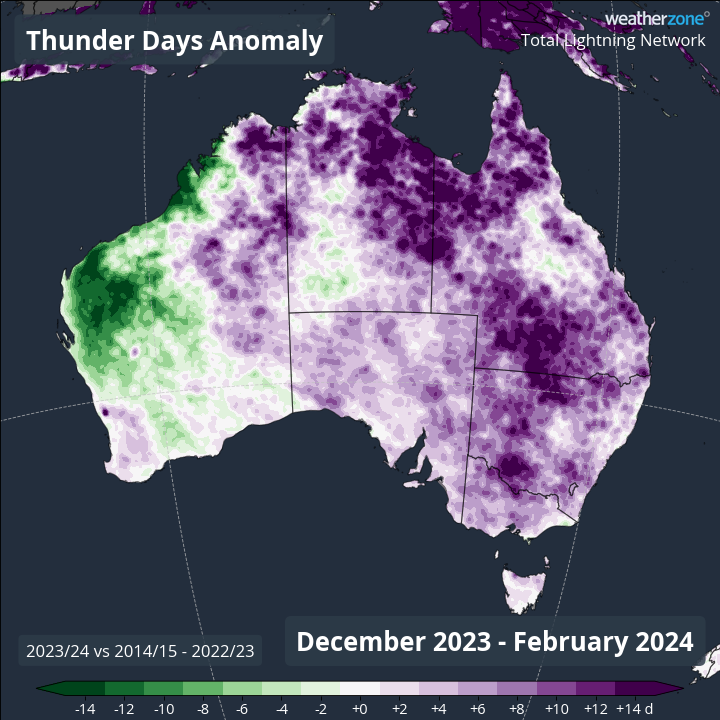
Images: Observed thunder days and thunder days anomalies for summer 2023-24 in Australia.

Of Australia’s capital cities, Darwin saw the most thunder days with 42 during summer, while Hobart had the least with just two. These numbers were slightly lower than average for summer in both cities.

Melbourne, Brisbane and Canberra all heard thunder more frequently than usual this summer, with each city registering around 5 to 6 extra thunder days compared to their seasonal averages.
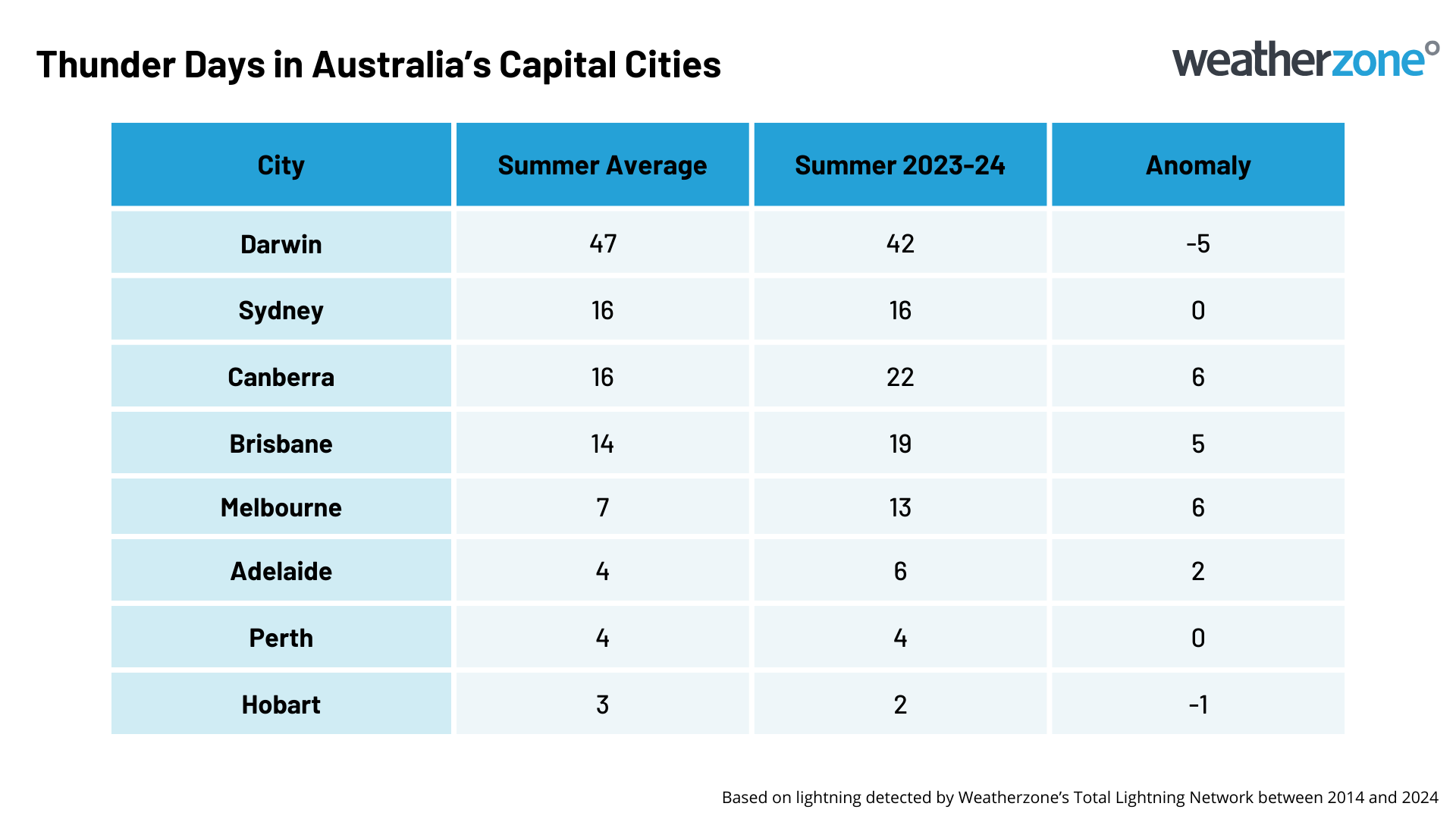
Image: Thunder days in Australia during summer 2023-24, compared to the long-term seasonal average.

Sydney and Perth saw their average number of thunder days this summer.

To find out more about our lightning and storm services, please email us at apac.sales@dtn.com.
Latest news

Satisfy your weather obsession with these news headlines from around the nation, and the world.

From Kimberley to northern NSW: Bushfire outlook flags risk for resources sector this winter

Bushfire risk doesn’t usually make headlines in June, but AFAC’s winter seasonal outlook is putting mining and resources operators on alert from the Kimberley to the NSW.  Australia’s official seasonal bushfire outlook for winter 2026 was released by AFAC on Thursday, May 28. The outlook predicts increased fire risk across the northern parts of the Great Sandy Desert and surrounds […]

The signal was there weeks earlier: forecasting one of the year’s biggest wind events

In mid-May 2026, DTN APAC meteorologists flagged a strengthening Southern Ocean pattern in model guidance, signalling an extended run of record-challenging wind conditions across the NEM.  Nearly three weeks later, NEM wind generation climbed from around 1.5GW to more than 9GW, supplying roughly one-third of the grid and coming within 1GW of the all-time generation record.  The event highlighted […]

The 2026 Indian Southwest Monsoon onset is expected in the next two weeks

The Indian Southwest Monsoon will reach India in the next two weeks, but a developing El Niño could signal a drier than normal monsoon for businesses and major industries across the country. Southwest monsoon onset over southern India in the next two weeks The Indian Meteorological Department (IMD) is responsible for tracking the advance and […]

Rapid El Niño signal accelerating risk for Australian businesses

El Niño–favourable conditions are gathering pace across the tropical Pacific, with key ocean indicators approaching threshold levels and early atmospheric responses emerging.  While uncertainty remains around final El Niño strength, historical analogues show that even weak events can generate widespread impacts, including reduced rainfall, warmer daytime temperatures, increased frost risk, elevated fire danger, reduced tropical cyclone activity, and more. Industries including […]