

Prosper in a dynamic world
Search

Record-warm oceans surrounded Australia in 2024

The Australian region set a new record for ocean temperatures in 2024, with sea surface temperatures close to 0.9°C above the long-term average.

Australia’s annual mean sea surface temperature during 2024 was 0.89°C above the 1961-1990 average. This was the highest annual sea surface temperature on record, beating the previous record anomaly of +0.80°C from 2022.
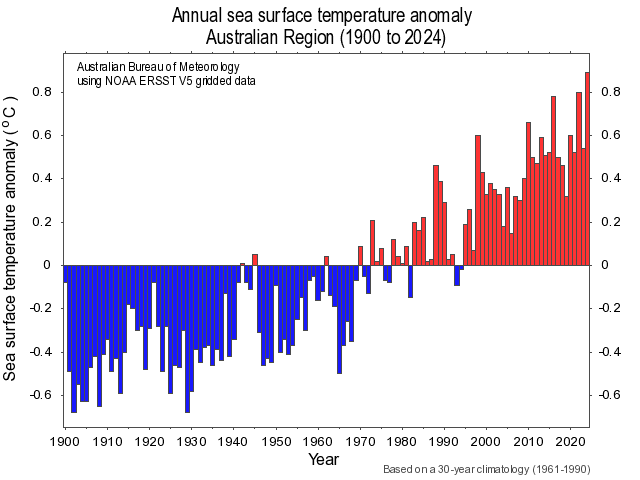
Image: Annual sea surface temperature anomalies in the Australian region between 1900 and 2024. Source: Bureau of Meteorology

January, February, October, November and December all set new records for their respective months. Every other month in 2024 ranked among the top three warmest on record for their respective months, based on data dating back to 1900.

The abnormally warm water surrounding Australia over the last 12 months was part of a larger story of record-breaking global oceanic heat in 2024.

According to data published by the Bureau of Meteorology, Earth’s global average annual sea surface temperature in 2024 was about 0.79°C above the 1960-1990 average. This is also a record, beating 0.74°C from 2023, despite the cooling influence of a La Niña-like pattern, which typically lowers the average global temperature.
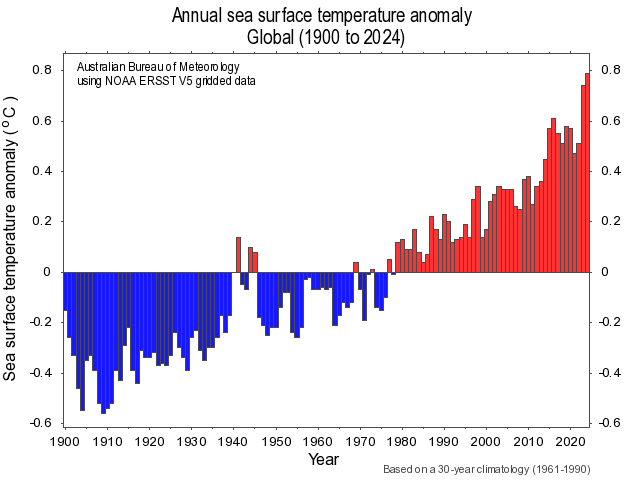
Image: Global annual sea surface temperature anomalies between 1900 and 2024. Source: Bureau of Meteorology

The graphs above reveal a clear warming trend in ocean temperatures. In the Australian region, sea surface temperatures have warmed by around 1.1°C since 1910 and warming has occurred around the entire country.
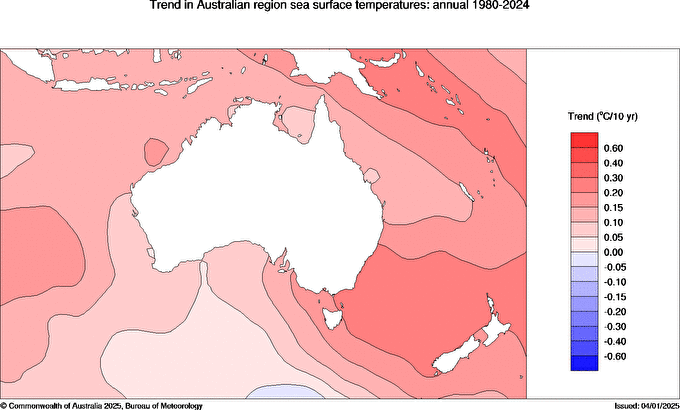
Image: Trend in sea surface temperatures near Australia between 1980 and 2024. Source: Bureau of Meteorology

The warm water surrounding Australia in 2024 was one of the reasons the country registered its second warmest year on record based on air temperature. It also helped make the air over Australia more humid than usual.

To find out more about how these SSTs could impact your business, please visit our website or email us at sales.apac@dtn.com.

Latest news

Satisfy your weather obsession with these news headlines from around the nation, and the world.

Australia’s 2025–26 Cyclone Season: Slightly Above Average, Dominated by Severe Systems

Australia has just experienced a highly impactful tropical cyclone season, with more than 60% of systems reaching severe intensity, causing widespread disruption and damage to communities and multiple industries across northern Australia.  The 2025–26 Australian tropical cyclone season officially ran from 1 November 2025 to 30 April 2026. During this six-month period, Australia saw 11 tropical cyclones, with nine […]

What does a ‘super El Niño’ mean for Australia’s businesses?

There are signs that a very strong, or ‘super’ El Niño could develop in the tropical Pacific Ocean later this year. So, what does this mean for Australia’s weather during the second half of 2026? El Niño on the horizon The tropical Pacific Ocean is currently in a neutral state, meaning neither El Niño nor […]

How does DTN help businesses monitor bushfire induced pyrocumulonimbus thunderstorms that ignite more fires?

Intense heat from bushfires during elevated fire danger days can trigger fire-induced pyrocumulonimbus thunderstorms that ignite additional fires. In early January 2026, an extreme heatwave sweeping over southeastern Australia brought catastrophic fire danger to Victoria. Intensely hot bush and grass fires spread erratically and quickly in hot, dry and gusty winds, with pyrocumulonimbus generating lightning, […]

Active seas to the north and east of Australia disrupting port and maritime operations

Seas to the north and east of Australia are experiencing periods of increased activity this week, leading to disruptions to port, maritime and offshore operations. Intense and hazardous Tasman Sea Ocean conditions across NSW’s South Coast rapidly deteriorated last Friday as a deep feed of easterly winds whipped up large and dangerous seas. The Batemans […]


